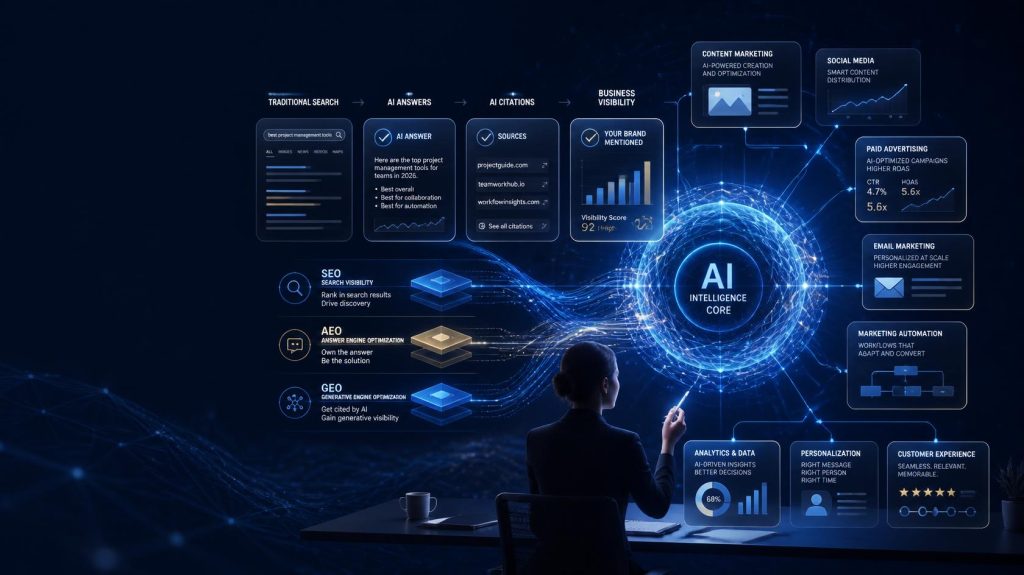
How AI Is Changing Digital Marketing in 2026: The Strategic Agency Guide
How AI Is Changing Digital Marketing in 2026: The Strategic Agency Guide Introduction: The Real Shift in 2026 In 2023, marketing leaders wondered whether artificial intelligence could draft email subject lines or generate blog posts. In 2024 and 2025, tools proliferated, creating an unprecedented flood of synthetic text, generic carousel slides, and cookie-cutter campaign drafts. But here in 2026, the novelty has completely evaporated. Marketing has progressed through five distinct epochs: traditional outbound advertising, web-based digital marketing, data-driven programmatic targeting, AI-assisted productivity, and now, AI-orchestrated search and hyper-personalized discovery. 2026 marks the turning point where sheer volume of content has become a liability rather than an asset. When any business can generate ten articles in sixty seconds at virtually zero marginal cost, content volume ceases to provide a sustainable competitive moat. The central challenge for business owners, entrepreneurs, and marketing teams in 2026 is no longer “How do we generate more marketing assets with AI?” The urgent strategic question is: “How do we build brand authority, genuine customer resonance, and verifiable trust in an ecosystem increasingly filtered by autonomous AI engines?” This comprehensive agency playbook breaks down the structural transformations reshaping search, content, social, paid advertising, and conversion funnels in 2026—and outlines exactly what your business should automate, what you must optimize, and what you must fiercely protect as human-led craft. What Is AI in Digital Marketing? Direct Answer / AEO Definition Snippet AI in digital marketing refers to the application of machine learning, natural language processing, generative algorithms, and predictive systems to analyze customer behavior, optimize real-time media bids, automate workflows, and deliver personalized commercial experiences across digital touchpoints without manual intervention. To understand how AI transforms commercial strategy in 2026, business leaders must differentiate between the underlying technologies that power modern platforms. Artificial intelligence is not a monolithic tool; it represents an interconnected stack of distinct computational capabilities: The Core Technology Stack • Machine Learning (ML): Algorithmic systems that identify patterns in historical datasets—such as consumer purchase paths or email open habits—to improve campaign performance automatically over time. • Generative AI (GenAI): Large language and multimodal models that synthesize original text, contextual imagery, personalized video snippets, and voice assets based on strategic prompt parameters. • Predictive AI: Statistical modeling engines that calculate the likelihood of future consumer actions, including customer churn probability, lifetime value (LTV) projections, and impending conversion readiness. • Autonomous AI Agents: Goal-oriented software agents capable of executing multi-step operational tasks—such as auditing ad bid anomalies, resolving complex customer service tickets, and orchestrating cross-channel messaging—without human micro-management. • Modern Marketing Automation: The rules-based and intelligent infrastructure connecting customer relationship management (CRM) platforms, email systems, and advertising pixels into unified customer lifecycles. Why AI Is Essential for Digital Marketing in 2026 Name Age Country Occupation John Doe 28 USA Software Engineer Jane Smith 32 UK Graphic Designer John Albert 24 Canada Data Scientist Maria Garcia 29 Spain Marketing Specialist Add Your Heading Text Here Lorem ipsum dolor sit amet, consectetur adipiscing elit. Ut elit tellus, luctus nec ullamcorper mattis, pulvinar dapibus leo. Click here Direct Answer / AEO Definition Snippet AI is essential in 2026 because exponential consumer data volumes and fragmented omni-channel touchpoints surpass human manual capacity. AI enables real-time personalization at scale, optimizes multi-platform ad spend within milliseconds, and navigates generative search engines that directly answer queries before users click traditional links. Four structural market forces have cemented AI as non-negotiable infrastructure for businesses in 2026: 1. The Collapse of Traditional Search Clicks: With AI Overviews dominating commercial and informational search queries, brands can no longer rely purely on page-one ranking positions to drive organic pipeline. Visibility requires being synthesized as an authoritative citation inside generative answers. 2. Unforgiving Consumer Expectations for Personalization: Modern consumers reject generic mass blasts. They expect website storefronts, retargeting sequences, and email recommendations to mirror their immediate context, budget constraints, and recent digital interactions. 3. Speed of Market Experimentation: High-performing marketing teams in 2026 run dozens of creative, copy, and audience hypotheses concurrently. Conducting multivariate testing at this velocity is mathematically impossible through manual spreadsheets and manual ad setup. 4. Signal Loss and First-Party Data Mining: As third-party cookies have become fully obsolete, marketing attribution relies heavily on first-party data. Machine learning algorithms are essential for modeling missing conversion paths and deciphering incrementality. 12 Major Ways AI Is Changing Digital Marketing in 2026 Below is a thorough examination of the 12 core operational transformations taking place across digital marketing departments, agencies, and growth teams today. 1. AI and Search Engine Optimization (SEO) Direct Answer / AEO Definition Snippet AI is changing SEO by shifting search engines from keyword string matching to semantic entity comprehension. In 2026, search algorithms evaluate topical depth, real-world author experience (E-E-A-T), and user engagement signals rather than keyword repetition, rendering keyword stuffing entirely obsolete. What Is Changing: Traditional SEO focused on selecting high-volume keywords, inserting them into meta tags, and building backlink volume. In 2026, search algorithms like Google Gemini-enhanced retrieval engines interpret entire topics, user intent journeys, and semantic entity relationships. How AI Is Responsible: Search engines utilize advanced natural language models to parse the contextual nuance behind user queries. The system evaluates whether a domain demonstrates genuine topical authority through interconnected, deeply researched content clusters rather than isolated articles. Practical Business Example: A local commercial HVAC contractor that previously created 50 thin pages for “HVAC repair in [town]” sees those pages de-indexed. In 2026, they consolidate their domain into a definitive Technical Knowledge Hub covering preventative maintenance schedules, commercial energy compliance codes, and real field diagnostic case studies. Their organic qualified inbound inquiries increase by 140%. Strategic Takeaway: Stop writing for bots. Build comprehensive topical hubs, incorporate verifiable first-hand project data, and ensure your site answers every logical follow-up question a prospective buyer possesses. 2. Answer Engine Optimization (AEO) Direct Answer / AEO Definition Snippet AEO (Answer Engine Optimization) is the discipline of structuring content to be directly selected and read aloud by voice assistants and displayed in zero-click search