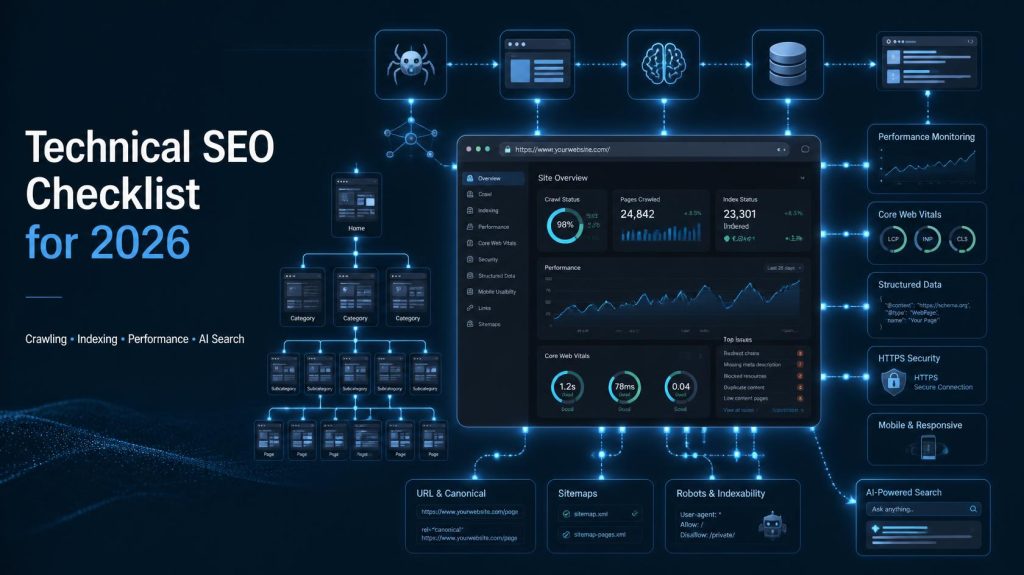
Technical SEO Checklist for 2026
2026 EDITION · UPDATED FOR AI SEARCH Technical SEO Checklist for 2026 The complete, practical, beginner-to-advanced audit framework for crawling, rendering, indexing, Core Web Vitals, structured data, and AI-powered search visibility. Crawl · Render · Index · Understand · Surface Your content can be genuinely excellent. Your backlink profile can be the envy of your niche. Your brand can be the most trusted name in the market. And yet, none of it matters if a search engine cannot crawl your pages, render your JavaScript, understand your structure, or index your most valuable URLs. That is the uncomfortable truth of modern SEO — visibility is permission-based, and technical SEO is how you earn permission. Search in 2026 is no longer a single blue-link experience. Traditional SERPs, AI Overviews, conversational assistants, and generative answer engines all compete for the same user attention. They share one dependency: they must be able to access, parse, and trust your content before they can surface it anywhere. This guide is the technical SEO checklist I use when auditing real client websites — from lean SaaS startups to multi-market e-commerce stores. It walks you through crawling, rendering, indexing, Core Web Vitals, structured data, JavaScript SEO, international setup, and the technical foundations that support AEO and GEO. Treat it as a working document, not a one-time read. What Is Technical SEO? Technical SEO is the practice of optimizing a website’s infrastructure so search engines can efficiently crawl, render, understand, and index its content. It covers crawling controls, indexing signals, site architecture, performance, mobile usability, structured data, HTTPS, and JavaScript rendering — the foundations that let everything else in SEO actually work. What Is Technical SEO? Technical SEO is the engineering side of search optimization. It is everything that happens between a search engine discovering your URL and a user actually seeing your page in a result. Where on-page SEO focuses on content quality and keyword relevance, and off-page SEO focuses on authority and links, technical SEO makes sure those efforts can be found, interpreted, and trusted in the first place. In practice, technical SEO answers one core question: can search engines access, understand, and use my content? Every task — from robots.txt to canonical tags to INP scores — is a supporting answer to that question. The five pillars of technical SEO Crawling — can search engine bots discover and fetch your URLs? Rendering — can they execute the JavaScript needed to see your content? Indexing — are pages eligible to be stored and shown in search results? Architecture & internal linking — is your site logically structured and navigable? Experience & trust — is the site fast, mobile-friendly, secure, and machine-readable? Technical SEO is not primarily about keyword placement, meta descriptions, or content writing. Those belong to on-page and content SEO. It is also not a magic ranking lever — it removes barriers so that great content and real authority can actually compete. The distinction that matters: Technical SEO, on-page SEO, off-page SEO, and content SEO are not competing disciplines. They are layers. Technical SEO is the foundation. Break it, and every other layer becomes invisible. Why Technical SEO Still Matters in 2026 It’s tempting to assume that as search engines get smarter, technical SEO matters less. The opposite is true. The more sophisticated the system, the more dependent it becomes on clean, machine-readable inputs. AI-powered search, entity understanding, and multimodal retrieval all require the same foundation: accessible, structured, trustworthy content. Why the technical layer remains decisive AI Overviews and answer engines still crawl first. Generative systems pull from indexed, renderable, well-structured content. If a page can’t be crawled or rendered, it can’t be cited. JavaScript-heavy sites are more common, not less. Modern frameworks (React, Next.js, Vue) introduce rendering complexity that generic SEO advice ignores. Mobile-first indexing is the default. Whatever your mobile page delivers is what Google uses for evaluation — desktop parity is not optional. Core Web Vitals are a page experience signal. LCP, INP, and CLS are not vanity metrics; they reflect real user friction. Large and international sites accumulate technical debt. Faceted navigation, hreflang, parameter bloat, and crawl waste don’t fix themselves. E-commerce competition is partly an indexing competition. The store with the cleanest URL and canonical strategy often wins the visibility war. Important nuance: Technical SEO helps search engines access and understand your content. It does not replace useful content, topical authority, or genuine relevance. Excellent technical SEO with weak content is still a losing strategy. Technical SEO Checklist for 2026 21 audit categories. Every item includes why it matters, what to check, how to fix it, priority level, and recommended tools. 1. Crawlability Crawlability is the entry point of technical SEO. If a search engine bot cannot fetch a URL, nothing downstream matters. Crawling and indexing are separate stages — a page can be crawlable but not indexable, and indexable but not indexed. High Priority Robots.txt Why it matters: Robots.txt controls which parts of your site search engine bots can crawl. A single wildcard or misplaced disallow can silently block entire sections from search. What to check: File exists at the root domain (when appropriate) Syntax is valid and directives are correctly formatted Important pages and resources are not accidentally blocked CSS and JS resources are not blocked — Google needs them to render Sitemap reference is included where appropriate Robots.txt is not being misused to remove already-indexed URLs How to fix it: Audit directives line by line in Search Console’s robots.txt report. Remember — crawl control ≠ index control. Blocking crawling in robots.txt does not guarantee removal from the index; you need a noindex directive or URL removal request. Tools: Google Search Console, Screaming Frog, Sitebulb High Priority XML Sitemap Why it matters: Sitemaps are a direct communication channel with search engines. They help discovery, especially for new or deeply nested URLs. What to check: XML sitemap exists and returns a 200 status Only canonical, indexable URLs are included No 404s, redirects, or noindex URLs listed Sitemap index is