How AI Is Changing Digital Marketing in 2026: The Strategic Agency Guide
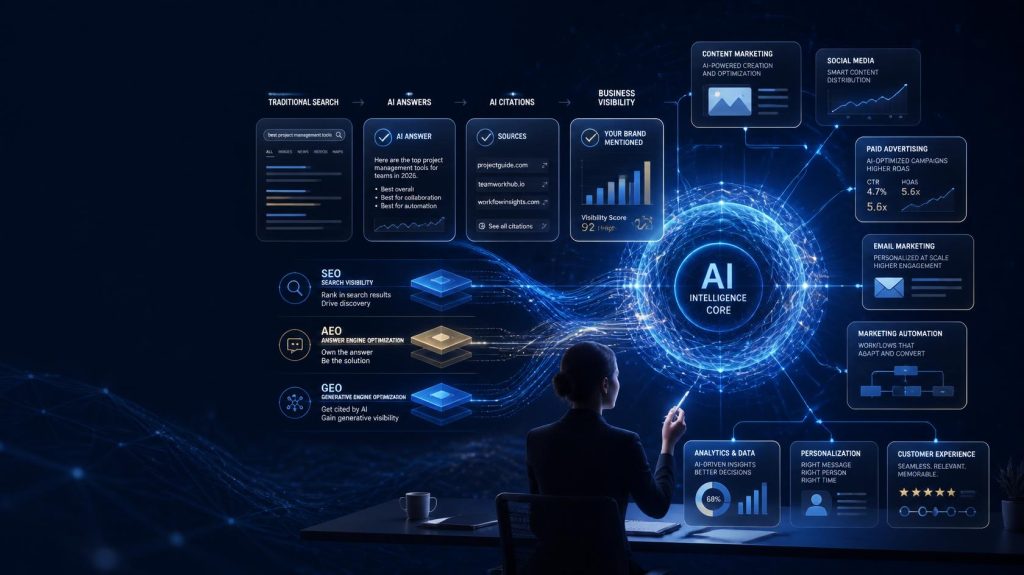
Introduction: The Real Shift in 2026
In 2023, marketing leaders wondered whether artificial intelligence could draft email subject lines or generate blog posts. In 2024 and 2025, tools proliferated, creating an unprecedented flood of synthetic text, generic carousel slides, and cookie-cutter campaign drafts. But here in 2026, the novelty has completely evaporated.
Marketing has progressed through five distinct epochs: traditional outbound advertising, web-based digital marketing, data-driven programmatic targeting, AI-assisted productivity, and now, AI-orchestrated search and hyper-personalized discovery. 2026 marks the turning point where sheer volume of content has become a liability rather than an asset. When any business can generate ten articles in sixty seconds at virtually zero marginal cost, content volume ceases to provide a sustainable competitive moat.
The central challenge for business owners, entrepreneurs, and marketing teams in 2026 is no longer “How do we generate more marketing assets with AI?” The urgent strategic question is: “How do we build brand authority, genuine customer resonance, and verifiable trust in an ecosystem increasingly filtered by autonomous AI engines?”
This comprehensive agency playbook breaks down the structural transformations reshaping search, content, social, paid advertising, and conversion funnels in 2026—and outlines exactly what your business should automate, what you must optimize, and what you must fiercely protect as human-led craft.
What Is AI in Digital Marketing?
Direct Answer / AEO Definition Snippet
AI in digital marketing refers to the application of machine learning, natural language processing, generative algorithms, and predictive systems to analyze customer behavior, optimize real-time media bids, automate workflows, and deliver personalized commercial experiences across digital touchpoints without manual intervention.
To understand how AI transforms commercial strategy in 2026, business leaders must differentiate between the underlying technologies that power modern platforms. Artificial intelligence is not a monolithic tool; it represents an interconnected stack of distinct computational capabilities:
The Core Technology Stack
• Machine Learning (ML): Algorithmic systems that identify patterns in historical datasets—such as consumer purchase paths or email open habits—to improve campaign performance automatically over time.
• Generative AI (GenAI): Large language and multimodal models that synthesize original text, contextual imagery, personalized video snippets, and voice assets based on strategic prompt parameters.
• Predictive AI: Statistical modeling engines that calculate the likelihood of future consumer actions, including customer churn probability, lifetime value (LTV) projections, and impending conversion readiness.
• Autonomous AI Agents: Goal-oriented software agents capable of executing multi-step operational tasks—such as auditing ad bid anomalies, resolving complex customer service tickets, and orchestrating cross-channel messaging—without human micro-management.
• Modern Marketing Automation: The rules-based and intelligent infrastructure connecting customer relationship management (CRM) platforms, email systems, and advertising pixels into unified customer lifecycles.
Why AI Is Essential for Digital Marketing in 2026
| Name | Age | Country | Occupation |
|---|---|---|---|
| John Doe | 28 | USA | Software Engineer |
| Jane Smith | 32 | UK | Graphic Designer |
| John Albert | 24 | Canada | Data Scientist |
| Maria Garcia | 29 | Spain | Marketing Specialist |
Add Your Heading Text Here
Lorem ipsum dolor sit amet, consectetur adipiscing elit. Ut elit tellus, luctus nec ullamcorper mattis, pulvinar dapibus leo.
AI is essential in 2026 because exponential consumer data volumes and fragmented omni-channel touchpoints surpass human manual capacity. AI enables real-time personalization at scale, optimizes multi-platform ad spend within milliseconds, and navigates generative search engines that directly answer queries before users click traditional links.
Four structural market forces have cemented AI as non-negotiable infrastructure for businesses in 2026:
1. The Collapse of Traditional Search Clicks: With AI Overviews dominating commercial and informational search queries, brands can no longer rely purely on page-one ranking positions to drive organic pipeline. Visibility requires being synthesized as an authoritative citation inside generative answers.
2. Unforgiving Consumer Expectations for Personalization: Modern consumers reject generic mass blasts. They expect website storefronts, retargeting sequences, and email recommendations to mirror their immediate context, budget constraints, and recent digital interactions.
3. Speed of Market Experimentation: High-performing marketing teams in 2026 run dozens of creative, copy, and audience hypotheses concurrently. Conducting multivariate testing at this velocity is mathematically impossible through manual spreadsheets and manual ad setup.
4. Signal Loss and First-Party Data Mining: As third-party cookies have become fully obsolete, marketing attribution relies heavily on first-party data. Machine learning algorithms are essential for modeling missing conversion paths and deciphering incrementality.
12 Major Ways AI Is Changing Digital Marketing in 2026
Below is a thorough examination of the 12 core operational transformations taking place across digital marketing departments, agencies, and growth teams today.
1. AI and Search Engine Optimization (SEO)
AI is changing SEO by shifting search engines from keyword string matching to semantic entity comprehension. In 2026, search algorithms evaluate topical depth, real-world author experience (E-E-A-T), and user engagement signals rather than keyword repetition, rendering keyword stuffing entirely obsolete.
What Is Changing: Traditional SEO focused on selecting high-volume keywords, inserting them into meta tags, and building backlink volume. In 2026, search algorithms like Google Gemini-enhanced retrieval engines interpret entire topics, user intent journeys, and semantic entity relationships.
How AI Is Responsible: Search engines utilize advanced natural language models to parse the contextual nuance behind user queries. The system evaluates whether a domain demonstrates genuine topical authority through interconnected, deeply researched content clusters rather than isolated articles.
Practical Business Example: A local commercial HVAC contractor that previously created 50 thin pages for “HVAC repair in [town]” sees those pages de-indexed. In 2026, they consolidate their domain into a definitive Technical Knowledge Hub covering preventative maintenance schedules, commercial energy compliance codes, and real field diagnostic case studies. Their organic qualified inbound inquiries increase by 140%.
Strategic Takeaway: Stop writing for bots. Build comprehensive topical hubs, incorporate verifiable first-hand project data, and ensure your site answers every logical follow-up question a prospective buyer possesses.
2. Answer Engine Optimization (AEO)
AEO (Answer Engine Optimization) is the discipline of structuring content to be directly selected and read aloud by voice assistants and displayed in zero-click search snippets. In 2026, it requires crisp 40–60 word definitions, question-focused subheadings, and clean schema markup.
What Is Changing: Over 50% of informational queries across desktop and mobile now culminate in zero-click resolutions. Users receive direct answers in featured boxes or voice prompts without visiting the source website unless they seek in-depth verification.
How AI Is Responsible: Conversational language models extract precise answers to complex user questions by matching query intent with structured text chunks. If your content buries the direct answer beneath 500 words of conversational preamble, the retrieval engine bypasses your page in favor of a competitor who stated the conclusion in sentence one.
Practical Business Example: A B2B accounting firm includes a bolded 50-word definition of “Section 179 deduction limits for 2026” directly below an H2 heading. Google features this exact block in the answer card, resulting in 2.3 million brand impressions and established brand authority among CFOs.
Strategic Takeaway: Adopt the “Inverted Pyramid” of editorial writing. Deliver the direct, factual answer immediately under the heading, then elaborate on nuances, exceptions, and strategic implications.
3. Generative Engine Optimization (GEO)
GEO (Generative Engine Optimization) optimizes digital content so generative search engines (such as Google AI Overviews, Perplexity, and ChatGPT Search) discover, understand, and cite your brand as an authoritative source in synthesized multi-paragraph answers.
What Is Changing: Generative search engines do not merely link to web pages; they ingest multiple web sources, synthesize a comprehensive overview, and cite 2 to 5 reference links in footnotes or interactive chips. Winning visibility requires being recognized as an indispensable consensus or counter-perspective source.
How AI Is Responsible: Generative engines rely on retrieval-augmented generation (RAG). When synthesizing an answer, the model looks for corroborated statistics, authoritative industry definitions, original research papers, and recognized domain entities.
Practical Business Example: A software development consultancy conducts an annual survey of 450 engineering leaders on microservices migration costs. When a prospect asks Perplexity or Google AI Overviews, “What is the average cost of enterprise cloud migration?”, the AI overview specifically cites their proprietary benchmark report in the primary summary sentence.
Strategic Takeaway: Generative engines prioritize unique information gain. If your article only summarizes what ten other articles already state, an AI engine has zero reason to cite you. Publish original surveys, proprietary data points, client interviews, and documented case studies.
4. Content Marketing & The Human-First Premium
In 2026, AI accelerates content ideation, outline generation, and multi-format repurposing. However, because AI creates an oversupply of generic content, audiences and search engines place a premium on human expertise, proprietary data, storytelling, and authentic opinions.
What Is Changing: The cost of creating mediocre, grammatically clean content has collapsed to zero. As a result, the internet is flooded with interchangeable blog posts that say nothing new. In response, consumers and search algorithms are actively hunting for human perspective, verified experience, and critical thinking.
How AI Should Be Used: Use AI as an elite research assistant. Have it cluster customer feedback, analyze competitor coverage gaps, build structured content briefs, and reformat written articles into podcast scripts or social snippets. Never let it generate unedited, unsupervised final copy.
Practical Business Example: An e-commerce outdoor gear brand stops churning out 20 generic “Top 10 Tents for Camping” articles. Instead, their founder spends an afternoon interviewing their head gear tester who just completed a 200-mile mountain expedition in sub-zero conditions. They use AI to transcribe the interview, organize the insights into a structured draft, and format the comparison specs. The resulting piece drives record engagement and high-intent sales because of authentic, un-faked field experience.
Strategic Takeaway: If an article could have been written by someone who has never touched your product, served your clients, or operated in your industry, do not publish it.
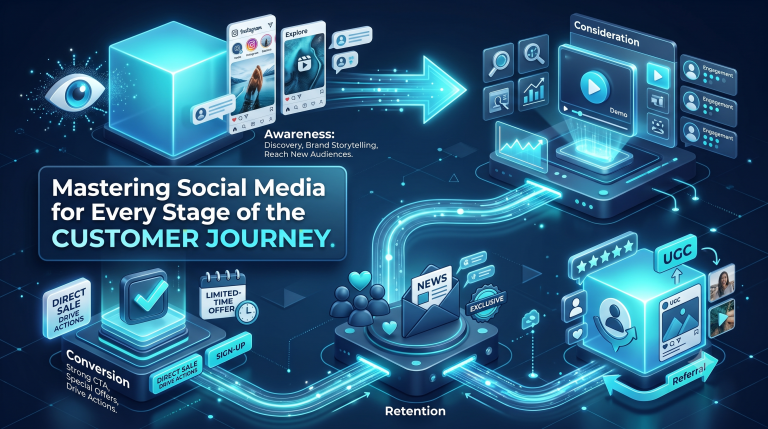
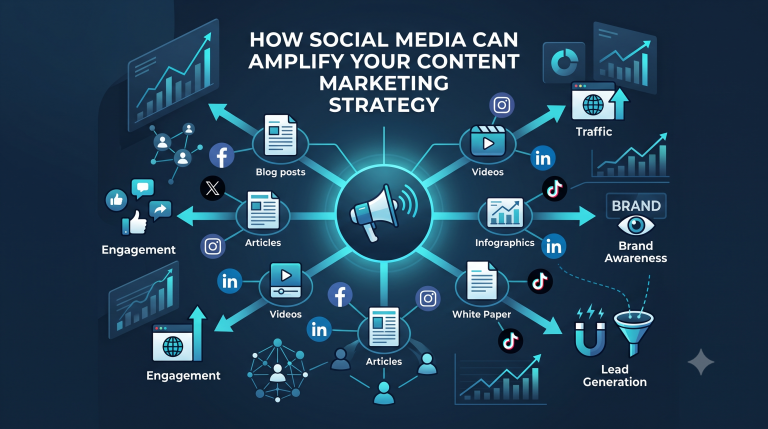
5. Social Media Marketing & Audience Listening
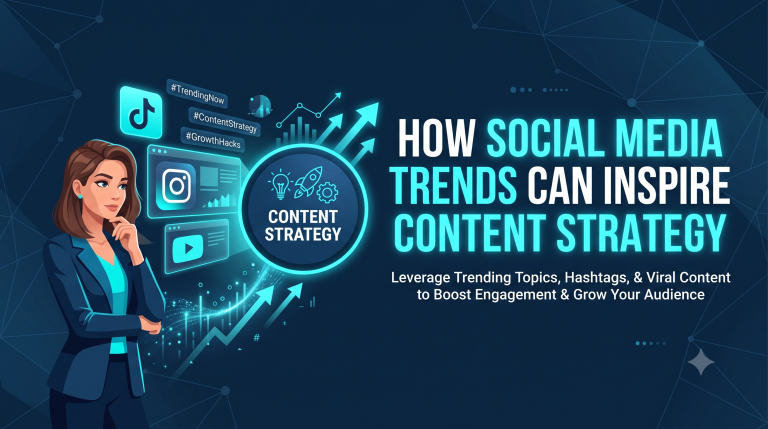
AI transforms social media in 2026 by detecting emerging cultural trends, analyzing audience sentiment across billions of daily posts, and personalizing distribution timing. Yet, real brand affinity still requires genuine, unscripted human interactions and executive points of view.
What Is Changing: The era of static social media scheduling queues publishing generic platitudes is dead. Feeds on LinkedIn, Meta, and X reward authentic conversations, real-time commentary on breaking industry news, and distinctive points of view.
How AI Is Responsible: Computer vision and natural language processing allow brands to perform predictive social listening. Marketing teams identify emerging customer frustrations, viral memes, and competitor service failures within minutes, giving them the data to formulate immediate responses.
Practical Business Example: A fintech startup utilizes AI listening tools to detect spikes in consumer confusion regarding new digital banking compliance mandates. Within four hours, their leadership team records a two-minute executive video breaking down the policy in plain English. The video goes viral across LinkedIn, positioning the brand as the proactive market authority.
Strategic Takeaway: Use AI to detect what your target market is talking about; rely on human leadership and brand champions to articulate your company’s unique perspective.
6. Paid Advertising: From Button-Clicking to Creative Direction
AI in paid advertising has automated bid management, audience targeting, and real-time placement allocation across Google Ads, Meta, and programmatic exchanges. In 2026, media buyers win by providing superior creative strategy, high-converting offer architecture, and accurate first-party conversion data.
What Is Changing: The role of the media buyer has shifted dramatically. In past years, ad managers spent hours manually tweaking keyword bids, exclusions, and micro-demographic target tiers. In 2026, algorithmic ad platforms (like Google Performance Max and Meta Advantage+) handle bidding and distribution autonomously.
How Marketers Compete: When every competitor has access to the exact same targeting algorithms, your media buying setup provides zero competitive edge. The modern performance marketer succeeds through creative direction: compelling hooks, visceral consumer problem identification, authentic video creatives, and irresistible offer structures.
Practical Business Example: A direct-to-consumer skincare brand running Meta Ads stops manually creating 50 narrow audience ad sets. They consolidate their budget into a single broad Advantage+ campaign and focus all energy on producing 15 distinct customer-story video angles every week. Their blended customer acquisition cost (CAC) drops by 32% because the algorithmic engine matches the right creative hook to the right consumer profile.
Strategic Takeaway: Treat the advertising algorithm as a powerful vehicle, but remember that your creative strategy and offer quality are the steering wheel and fuel.
7. Email Marketing & Predictive Lifecycle Sequences
AI transforms email marketing in 2026 by moving beyond fixed time-drip sequences into predictive, behavior-triggered cadences. Machine learning models analyze individual subscriber interaction habits to deliver tailored content, dynamic product suggestions, and optimal send times.
What Is Changing: Traditional email drip campaigns send Day 1, Day 3, and Day 7 messages regardless of what the user is actually doing. In 2026, email platforms use predictive AI to gauge purchase propensity, interest category, and engagement decay in real time.
How AI Is Responsible: Intelligent CRM engines continuously recalculate each subscriber’s churn risk and purchase intent score. If a customer visits a pricing page twice in 24 hours, the system halts their standard educational sequence and delivers a targeted case study addressing ROI.
Practical Business Example: An online learning platform uses predictive email AI to analyze video lesson completion rates. When the model detects a 70% probability that a student is falling behind and likely to cancel their membership, it automatically triggers a personalized encouragement email from a mentor offering a 1-on-1 check-in. Student churn drops by 24%.
Strategic Takeaway: Shift from static calendar-based broadcasts to intelligent, trigger-based lifecycle messaging that responds dynamically to customer behavior.
8. Customer Personalization at Scale
AI-driven customer personalization in 2026 dynamically tailors website headlines, navigation menus, product recommendations, and special offers to an individual visitor’s industry, past behavior, and referral context without requiring manual variant creation.
What Is Changing: Static landing pages are yielding lower conversion rates. When a prospect clicks an ad or search result in 2026, they expect the digital destination to immediately reflect their specific industry, company size, and specific pain points.
How AI Is Responsible: Edge computing and fast LLM inference allow websites to dynamically assemble page components. If an enterprise healthcare executive visits your SaaS site, the homepage hero banner showcases healthcare case studies and HIPAA compliance credentials. If an e-commerce startup founder visits, the same URL highlights automated shop integrations.
Practical Business Example: A B2B software vendor implements dynamic AI page personalization. Enterprise visitors see enterprise pricing, security badges, and enterprise testimonials, while boutique agency visitors see agile workflow templates. Blended lead-to-opportunity conversion increases by 41%.
Strategic Takeaway: Break your core marketing collateral into modular components that intelligent systems can dynamically match to distinct visitor personas.
9. Marketing Automation & Autonomous Lead Nurturing
Modern AI marketing automation connects website visitors, CRM data, and sales pipelines through intelligent qualification workflows. Rather than forcing prospects into rigid forms, AI agents conduct natural conversational discovery and route qualified leads instantly to sales reps.
What Is Changing: The days of making a qualified prospect fill out an 8-field form and wait 48 hours for a sales rep to email them are over. In 2026, high-intent buyers demand immediate answers and frictionless booking.
How AI Is Responsible: Intelligent multi-agent workflows handle initial visitor qualification in real time. An AI concierge on your website can answer technical integration questions, verify budget and timeline fit, check account executive availability on Google Calendar, and book a confirmed demo in under two minutes.
Practical Business Example: A logistics technology company replaces their static “Request a Quote” form with an interactive AI consultation widget. The agent reviews the prospect’s fleet size and regional routes, provides a preliminary cost benchmark, and routes pre-qualified opportunities directly to the enterprise sales queue. Lead response time drops from 18 hours to 45 seconds, doubling demo show-up rates.
Strategic Takeaway: Use automation to eliminate friction between buyer interest and sales fulfillment, ensuring humans step in at the moment of highest relationship value.
10. Marketing Analytics, Attribution & Anomaly Detection
AI analytics in 2026 replaces descriptive dashboards with predictive anomaly detection and automated attribution modeling. Instead of manually inspecting rows in Google Analytics 4, marketers receive natural language executive briefings detailing campaign shifts and root causes.
What Is Changing: Marketers have spent the last decade drowning in data while starving for actionable insight. In 2026, analytics systems do not simply display charts; they proactively identify statistical variances, uncover hidden correlation patterns, and suggest budget reallocations.
How AI Is Responsible: Machine learning models continuously ingest omnichannel data streams—ad spend, organic traffic, CRM pipeline stages, and server health. When conversion rates on a specific mobile browser suddenly drop 15%, the AI alerts the technical team to a broken checkout script before human analysts even notice the anomaly.
Practical Business Example: An omni-channel retailer uses AI attribution modeling that evaluates cross-device exposure across TikTok, Google Search, and connected TV. The model demonstrates that brand search volume surges 48 hours after local podcast ad placements, allowing the CMO to defend and expand brand-building budgets that traditional last-click attribution had undervalued.
Strategic Takeaway: Transition your marketing reviews from backward-looking reporting (“what happened last month?”) to forward-looking predictive action (“what should we adjust this week?”).
11. Lead Generation & Precision Intent Scoring
AI in lead generation identifies accounts displaying in-market buying signals before they fill out a form. In 2026, predictive models analyze content consumption, hiring trends, and tech-stack changes to pinpoint high-probability prospects for outbound engagement.
What Is Changing: Cold email blast campaigns to unvetted lists have reached sub-1% response rates due to advanced AI email spam filters. Successful B2B lead generation now demands pinpoint relevance and timing based on real intent signals.
How AI Is Responsible: AI intent platforms correlate external data triggers—such as executive job changes, funding announcements, and specialized search research across peer review sites—with internal website engagement to generate dynamic Account Propensity Scores.
Practical Business Example: A cybersecurity firm uses AI intent scoring to prioritize outbound SDR focus. When a target enterprise in financial services hires a new Chief Information Security Officer and begins researching data encryption whitepapers, the system alerts the account executive. Outreach is customized to their exact infrastructure challenges, generating an 18% meeting booking rate on cold accounts.
Strategic Takeaway: Replace mass outbound spray-and-pray tactics with signal-based selling, targeting only organizations demonstrating active commercial need.
12. Customer Experience (CX) & Conversational Commerce
AI customer experience in 2026 merges pre-sale discovery, checkout assistance, and post-purchase support into a seamless conversational interface. Customers can query product specifications, check order status, or receive personalized styling guidance through natural dialogue.
What Is Changing: Customer support and digital marketing used to be separated into distinct corporate silos. In 2026, customer experience is recognized as the ultimate retention and referral marketing channel.
How AI Is Responsible: Modern multimodal AI concierges understand photos of damaged items, decipher complex technical manuals, and maintain conversation memory across months of interaction. They resolve 70% of routine inquiries instantly while escalating nuanced emotional issues to trained human specialists.
Practical Business Example: An e-commerce furniture brand introduces an AI interior design assistant. Shoppers upload a photo of their living room, and the assistant suggests coordinated couches, rugs, and lighting with accurate dimensions and color palette compatibility. Returns decrease by 28%, while average order value (AOV) increases by 35%.
Strategic Takeaway: View customer service not as an operational cost center, but as a primary driver of repeat revenue and brand loyalty powered by intelligent assistance.
Realistic Benefits of AI for Businesses in 2026
The realistic benefits of AI in digital marketing include 30–50% reductions in routine operational turnaround times, continuous 24/7 campaign optimization, granular personalization for thousands of customer segments, and superior capital efficiency across paid media channels.
When business owners strip away exaggerated vendor hype, artificial intelligence delivers four verifiable competitive advantages:
• Operational Velocity & Agility: What once took a marketing department three weeks to research, draft, design, and configure can now be tested in three days, enabling businesses to react instantly to market shifts.
• Elimination of Monotonous Repetitive Tasks: Freeing skilled marketers from manual CSV exports, daily bid adjustments, and routine copy variations allows them to invest their time in strategic brand positioning, creative breakthroughs, and customer interviews.
• Capital Efficiency Across Paid Media: By eliminating underperforming ad placements and automatically reallocating budgets to winning creative assets in real time, AI engines prevent wasted advertising spend.
• Unlocking Latent Value in First-Party Data: AI surfaces behavioral trends, high-margin customer cohorts, and impending churn risks that no human team could identify manually in thousands of spreadsheet rows.
Risks, Pitfalls, and Limitations of AI Marketing
Key risks of AI marketing include factual hallucinations that damage brand credibility, generic messaging that erodes brand differentiation, algorithmic bias, copyright liability, and algorithmic penalties from search engines for publishing low-value synthetic content.
Adopting AI without strict governance introduces severe operational liabilities that every marketing leader must mitigate:
1. Factual Hallucinations and Inaccurate Claims: Language models will occasionally invent product capabilities, fabricate legal guidelines, or misquote pricing. Unchecked AI outputs published on public channels can lead to severe brand embarrassment and regulatory exposure.
2. The “Sea of Sameness” & Brand Voice Dilution: Because LLMs predict the most statistically probable next words, unedited AI content naturally gravitates toward corporate clichés (“streamline,” “revolutionize,” “unleash”). Brands that rely exclusively on AI lose their authentic personality and distinct market voice.
3. Intellectual Property and Privacy Liabilities: Feeding proprietary client data, confidential trade secrets, or unreleased product roadmaps into public AI models can breach customer privacy agreements and copyright protections.
4. Over-Automation and Algorithmic Disconnection: When marketing automation runs without continuous human review, bizarre anomalies occur—such as cheerily automated promotional emails firing during corporate crises or natural disasters.
What Marketers Should NEVER Automate
Marketers should never automate core brand positioning, strategic vision, final editorial approval, sensitive crisis communications, customer empathy in high-stakes conflicts, or authentic relationship building. AI should augment human capability, not replace human judgment.
The most critical marketing decisions in 2026 are the ones kept strictly in human hands. If you automate the following areas, you jeopardize the foundation of your business:
• Brand Positioning & Core Value Proposition: An algorithm cannot feel market friction or intuitively understand why early customers took a bet on your founding team. Deciding who your business serves and what you stand for is an inherently human responsibility.
• Original Philosophical Opinions & Thought Leadership: Thought leadership requires courage, conviction, and taking an unconventional stance on industry controversies. AI can only synthesize the existing consensus of what has already been written.
• Final Quality & Accuracy Sign-Off: Never allow any AI system to publish live to a public audience without a qualified human editor reviewing the text for truthfulness, tone, and brand safety.
• High-Stakes Customer Conflict Resolution: When an enterprise client or dissatisfied customer experiences a major service failure, sending an automated robotic response triggers fury. True empathy, accountability, and commercial judgment cannot be synthesized.
• Ethical Guidelines and Marketing Boundaries: Setting the ethical boundary for how your company uses customer data and addresses consumer vulnerabilities requires moral agency—a trait software does not possess.
How Small Businesses & Startups Can Practically Adopt AI
Small businesses should adopt AI through a 6-step framework: 1) Identify time-draining repetitive tasks, 2) Choose targeted, high-utility tools, 3) Build documented workflows, 4) Keep human review in the loop, 5) Measure business outcomes over vanity metrics, and 6) Continuously refine processes.
Step 1: Conduct a Time & Friction Audit
List every recurring marketing task your team performs each week. Identify tasks that require less than 10% creative ingenuity but consume 40% of working hours (e.g., reformatting social captions, summarizing call notes, checking broken links, formatting newsletters).
Step 2: Start with Targeted, Specialized Tools
Avoid the trap of buying massive, convoluted enterprise software suites. Begin with one high-impact area: an AI writing assistant for drafting outlines, an AI ad creative generator, or an automated scheduling agent.
Step 3: Document Standard Operating Procedures (SOPs)
Create clear internal prompt templates and brand voice guides. Specify your target persona, tone rules, banned buzzwords, and mandatory review steps so team members produce consistent, high-quality results.
Step 4: Maintain the “Human in the Loop” Rule
Establish a mandatory editorial checkpoint. Every single piece of content, automated email, or ad copy must pass through human hands for factual verification, emotional resonance, and brand integrity before deployment.
Step 5: Measure Commercial KPIs, Not Output Vanity
Do not celebrate generating 50 blog posts if your organic revenue remains flat. Measure AI success by pipeline acceleration, customer acquisition cost (CAC) reduction, lead response speed, and customer retention.
Step 6: Refine, Cull, and Iterate
Audit your software stack every quarter. Cancel subscriptions for tools that do not demonstrate clear operational time savings or revenue impact.
Will AI Replace Digital Marketers?
AI will not replace digital marketers, but marketers who skillfully leverage AI will rapidly replace those who do not. AI automates mechanical tasks like bid tweaks and basic copywriting, elevating human marketers into strategic directors, creative storytellers, and customer psychologists.
The honest answer is nuanced: AI is undeniably eliminating demand for low-level, mechanical marketing labor. If a freelancer or agency’s sole value proposition is churning out generic 800-word articles or manually adjusting Google Ads keyword bids by $0.10, their business model is obsolete.
However, the strategic, creative, and leadership demands of digital marketing have never been more critical. The modern marketer in 2026 is transitioning from a tactical technician to an orchestrator:
• From Copywriter to Chief Editor: Guiding voice, tone, emotional nuance, and compelling narrative arc while leveraging AI to accelerate drafting.
• From Media Buyer to Creative Strategist: Designing irresistible consumer offers, visual hooks, and psychological angles that fuel algorithmic ad systems.
• From Keyword Chaser to Topical Architect: Structuring holistic, authoritative knowledge bases that establish industry-wide domain expertise.
• From Data Collector to Business Storyteller: Translating complex attribution patterns into decisive commercial recommendations for executive leadership.
The Future of AI in Digital Marketing (2026 and Beyond)
The future of digital marketing centers on multi-agent collaboration, multimodal search, zero-party data networks, and conversational commerce. Brands will optimize not just for human browsing, but for autonomous AI agents that make buying decisions on behalf of consumers.
As we look toward the remainder of the decade, three major technological frontiers are emerging:
1. Autonomous Machine-to-Machine Commerce (B2Agent): Within the next three to five years, consumer AI agents will begin managing routine purchasing. A consumer will tell their personal assistant, “Order eco-friendly laundry detergent with sensitive-skin formulation under $25.” Brands will need to optimize their product data, reputation signals, and pricing structures so that AI decision-making agents select their product over alternatives.
2. Multimodal and Spatial Search: Search behavior is rapidly expanding beyond typed text into spoken voice queries, live camera feeds (visual search), and augmented reality overlays. Brands must ensure their visual assets, 3D product models, and physical storefronts are semantically indexable.
3. The Supremacy of Community and Zero-Party Data: As public internet content becomes increasingly saturated with synthetic material, consumers are retreating into private communities—Discord servers, private Slack groups, niche forums, and gated memberships. Direct customer relationships and voluntary zero-party data will become the most valuable assets in marketing.
How Businesses Should Prepare for the AI-Driven Future
Lorem ipsum dolor sit amet, consectetur adipiscing elit. Ut elit tellus, luctus nec ullamcorper mattis, pulvinar dapibus leo.
Below is a high-priority operational checklist for business owners and marketing executives to ensure their digital infrastructure is optimized for 2026 and beyond:
- Build Robust First-Party and Zero-Party Data Assets: Eliminate reliance on third-party tracking; grow owned email lists, SMS subscribers, and direct customer accounts.
- Audit Content for Demonstrable First-Hand E-E-A-T: Review your top 20 traffic pages and inject real case studies, original screenshots, proprietary metrics, and verified expert author bios.
- Implement Structured Schema Markup Across All Pages: Deploy Article, FAQPage, Organization, and Product schemas to make your content machine-readable for AI retrieval systems.
- Optimize for Zero-Click and Conversational Search: Structure key informational pages with concise 40–60 word answer boxes beneath question-focused H2s.
- Shift Paid Media Resources into Creative Production: Transition from manual ad bid management to producing 5–10 fresh creative concepts, hooks, and video formats weekly.
- Establish Clear Brand Voice and AI Editorial Guidelines: Define strict rules for how your team uses AI, including mandatory human verification and tone preservation.
- Deploy Real-Time Conversational Lead Qualification: Replace static 48-hour contact forms with intelligent, instantaneous website discovery tools.
- Focus Analytics on Predictive Lifetime Value (LTV): Move beyond last-click attribution toward holistic media mix modeling and cohort retention metrics.
- Consolidate Fragmented Content into Topical Authority Hubs: Delete or merge thin, redundant blog posts into definitive, comprehensive industry resources.
- Foster Direct Human Communities: Build spaces where your audience can engage directly with your leadership and fellow practitioners without algorithmic intermediaries.
Conclusion: The True Moat in the Age of Artificial Intelligence
The greatest misconception about digital marketing in 2026 is that the business with the most advanced AI tools will automatically win. In reality, tools are commodities. Every one of your competitors has instant access to the exact same generative language models, algorithmic advertising platforms, and automated workflow engines that you do.
When technology becomes ubiquitous, human elements become the sole differentiator. The true competitive moat in 2026 consists of:
• Verifiable Real-World Trust: What customers say about your reliability when your software is not in the room.
• Distinctive Brand Perspective: Having the courage to state clear opinions, challenge stale industry dogma, and stand for an authentic ethos.
• Proprietary Data and Experience: Sharing insights that can only be earned through real client work, real product failures, and real market experimentation.
• Empathetic Customer Relationships: The genuine human care you exhibit at every critical customer touchpoint.
AI does not replace the art of marketing; it strips away the mechanical busywork so that true strategic marketing can flourish. The winners in 2026 will not be the companies that attempt to automate away every human interaction. The winners will be the forward-thinking businesses that use artificial intelligence to handle the arithmetic of marketing—freeing their people to focus on the soul of marketing.
FAQ
Frequently Asked Questions About AI in Digital Marketing
Concise, direct answers structured for conversational search engines, voice assistants, and marketing practitioners.
Property owners and tenants can claim and track their property to monitor the estimated value and learn about recent sales for similar properties. By understanding your relationship to the property, we can tailor what we show and send you to make claim and track their property to monitor the estimated value and learn it more relevant.
There is no limit to the number of properties you can track. Once you have tracked a property you will be able to track additional properties, make changes to your property relationship and change your primary property.
There is no limit to the number of properties you can track. Once you have tracked a property you will be able to track additional properties, make changes to your property relationship and change your primary property.
Price estimates are calculated by PropTrack Australia by looking at multiple properties and local market data points, which together can provide insight into the approximate value of a property. The data that informs the estimate range includes property and local market data including: Property types, Recent sales & local price trends, and Land area. To learn more about privacy and Property Value pages.
Price estimates are calculated by PropTrack Australia by looking at multiple properties and local market data points, which together can provide insight into the approximate value of a property. The data that informs the estimate range includes property and local market data including: Property types, Recent sales & local price trends, and Land area. To learn more about privacy and Property Value pages.
The Australian arm of PropTrack was acquired by REA Group In May 2018. A combination of unique data, industry expertise and analytical precision has made PropTrack a trusted leader in property data and automated valuations. From November 2018, PropTrack has been providing REA with most of the property insights used in consumer and customer experiences. More information about PropTrack is available on their website.
Section Title