The Complete Digital Marketing Funnel Explained
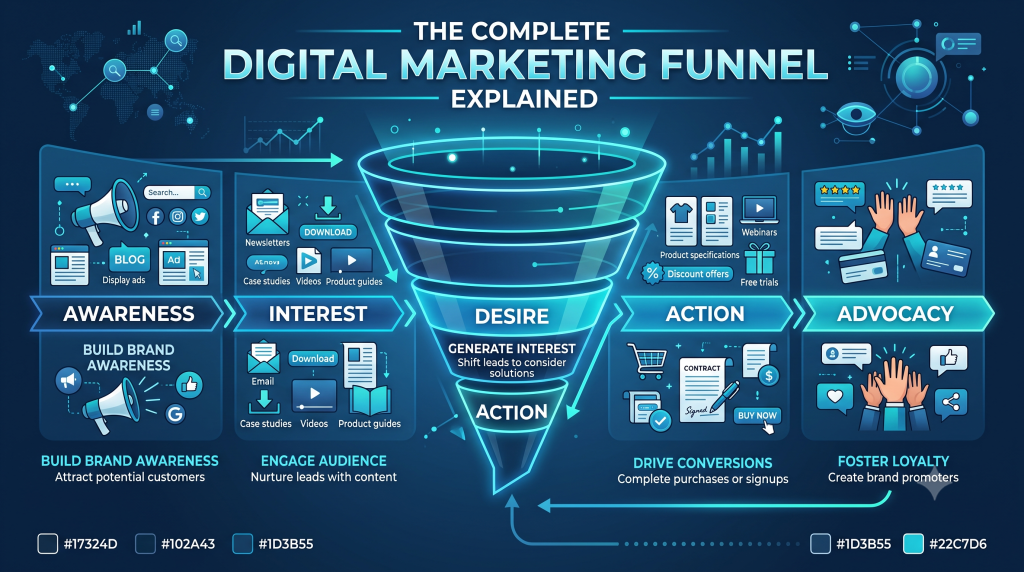
What Is a Digital Marketing Funnel? Quick answer: A digital marketing funnel is a framework that maps the journey a person takes from first discovering your brand to becoming a paying customer — and eventually an advocate. Most funnels have five to six stages: awareness, interest, consideration, conversion, retention, and advocacy. Each stage needs different content, channels, and calls to action because customer intent changes as people move through the journey. Jump to the funnel stages Table of Contents What Is a Digital Marketing Funnel? How Does a Digital Marketing Funnel Work? Digital Marketing Funnel Stages Funnel Stage Comparison Table Example: Local Dental Clinic Example: E-commerce Business Marketing Channels and Their Role Content for Every Funnel Stage Digital Marketing Funnel KPIs How to Build a Digital Marketing Funnel Common Funnel Mistakes How to Optimize a Funnel SEO + AEO + GEO Marketing Funnel vs Sales Funnel Frequently Asked Questions Final Takeaways Section 1 — What Is a Digital Marketing Funnel? A digital marketing funnel is a model that describes the sequence of steps a person typically goes through before buying from you — and what happens after they buy. It’s called a “funnel” because the number of people narrows at each stage: many people become aware of you, fewer show real interest, fewer still evaluate you seriously, and only a portion convert into customers. The purpose is simple: instead of treating every visitor, follower, and subscriber the same way, you match your message to where the person actually is. The funnel represents the customer journey The funnel is essentially a simplified visual of the customer journey — the real, non-linear path people take from “I have a problem” to “I’m a happy customer.” Why people don’t buy immediately Very few purchases are instant. Buying usually involves risk — financial, social, or emotional. People ask: Do I actually have this problem? Is there a better way to solve it? Which option is right for my situation? Can I trust this company? What happens if it doesn’t work? Marketing funnel vs sales funnel The marketing funnel covers the entire journey — awareness through advocacy. The sales funnel is narrower: qualifying leads, handling objections, and closing deals. In practice they overlap heavily. Real-world example: A homeowner notices their energy bill rising. They search “why is my electricity bill so high?” (awareness). They read a blog post about insulation (interest). They compare three insulation companies (consideration). They book a quote (conversion). They refer a neighbour six months later (advocacy). Section 2 — How Does a Digital Marketing Funnel Work? A funnel works by guiding people through a sequence of stages, each with a different goal and a different level of commitment. The most common modern model looks like this: Awareness → Interest → Consideration → Conversion → Retention → Advocacy Each arrow represents a decision point. At every arrow, some people move forward and some drop off. Your job isn’t to eliminate drop-off entirely — it’s to reduce unnecessary friction and keep the right people moving. Not every business uses the same funnel model There is no single universally correct funnel framework. Funnel frameworks vary depending on: Business model — e-commerce, SaaS, agency, local service Industry — regulated industries often have longer journeys Customer buying cycle — coffee takes minutes; enterprise software takes months Product price — higher price usually means more research Sales complexity — self-serve skips stages a sales team would own Customer intent — some visitors arrive ready to buy; others are curious Use the six-stage model below as a starting framework, then adapt it to your business. Section 3 — Digital Marketing Funnel Stages Below is a detailed breakdown of each stage: what it means, what the customer is thinking, the main objective, the best channels, the content that works, example CTAs, and KPIs. Stage 1: Awareness What it means: The person becomes aware that a problem exists, or that a category of solution exists. What the customer is thinking: “Why is this happening?” “What is…?” “How does… work?” Customer intent: Informational. Main objective: Get discovered by the right people and be genuinely useful. Best channels: SEO, blog content, YouTube, social media, display advertising, paid social, PR, influencer partnerships. Recommended content: How-to guides, explainers, myth-busting posts, short-form video, infographics. Example CTA: “Read the full guide.” KPIs: Impressions, reach, organic sessions, brand searches, video views. Stage 2: Interest What it means: The person recognises your content is relevant and begins exploring more deeply. Intent: Exploratory — with a personal stake. Main objective: Earn permission to keep the conversation going. Lead capture begins here. Best channels: Blog, newsletter, YouTube, webinars, lead magnets, email subscription. Recommended content: Deeper guides, checklists, templates, calculators, email courses. Example CTA: “Download the checklist.” KPIs: Email signups, downloads, engagement rate, returning visitors. Stage 3: Consideration What it means: The person is actively evaluating solutions and comparing options. Intent: Commercial investigation. Main objective: Become the obvious, trustworthy choice — reduce perceived risk. Best channels: Product/service pages, comparison pages, case studies, review platforms, retargeting, email nurturing, demos. Recommended content: Case studies, comparison pages, testimonials, detailed FAQs, pricing explainers, ROI calculators. Example CTA: “Book a demo.” KPIs: Qualified leads, demo requests, content-assisted conversions. Stage 4: Conversion What it means: The prospect takes the action you want — booking, trial, quote, or purchase. Intent: Transactional. Main objective: Remove friction and make the next step unmistakably clear. Best channels: Optimised landing pages, email sequences, retargeting, high-intent paid search, sales conversations. Recommended content: Landing pages, pricing pages, booking forms, free trials, guarantees, reviews. Example CTA: “Start your free trial.” KPIs: Conversion rate, CPA, cart abandonment, revenue, ROAS. Common friction: Long forms, hidden pricing, slow pages, missing trust signals, surprise costs, no mobile optimisation. Stage 5: Retention What it means: The customer has purchased. Now deliver real value, reduce churn, grow the relationship. Intent: Post-purchase — seeking confirmation and value. Main objective: Increase LTV and reduce churn. Best channels: Email, onboarding sequences, in-app messaging, support, community, SMS. Recommended content: Onboarding guides, how-to videos, tips,