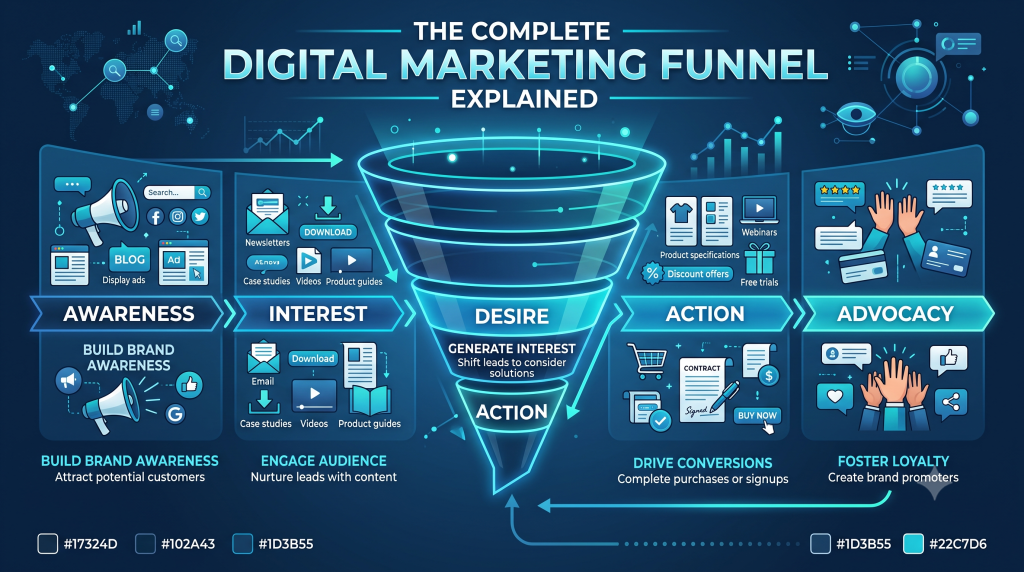
What Is a Digital Marketing Funnel?
Quick answer: A digital marketing funnel is a framework that maps the journey a person takes from first discovering your brand to becoming a paying customer — and eventually an advocate. Most funnels have five to six stages: awareness, interest, consideration, conversion, retention, and advocacy. Each stage needs different content, channels, and calls to action because customer intent changes as people move through the journey.
Table of Contents
- What Is a Digital Marketing Funnel?
- How Does a Digital Marketing Funnel Work?
- Digital Marketing Funnel Stages
- Funnel Stage Comparison Table
- Example: Local Dental Clinic
- Example: E-commerce Business
- Marketing Channels and Their Role
- Content for Every Funnel Stage
- Digital Marketing Funnel KPIs
- How to Build a Digital Marketing Funnel
- Common Funnel Mistakes
- How to Optimize a Funnel
- SEO + AEO + GEO
- Marketing Funnel vs Sales Funnel
- Frequently Asked Questions
- Final Takeaways
Section 1 — What Is a Digital Marketing Funnel?
A digital marketing funnel is a model that describes the sequence of steps a person typically goes through before buying from you — and what happens after they buy. It’s called a “funnel” because the number of people narrows at each stage: many people become aware of you, fewer show real interest, fewer still evaluate you seriously, and only a portion convert into customers.
The purpose is simple: instead of treating every visitor, follower, and subscriber the same way, you match your message to where the person actually is.
The funnel represents the customer journey
The funnel is essentially a simplified visual of the customer journey — the real, non-linear path people take from “I have a problem” to “I’m a happy customer.”
Why people don’t buy immediately
Very few purchases are instant. Buying usually involves risk — financial, social, or emotional. People ask:
- Do I actually have this problem?
- Is there a better way to solve it?
- Which option is right for my situation?
- Can I trust this company?
- What happens if it doesn’t work?
Marketing funnel vs sales funnel
The marketing funnel covers the entire journey — awareness through advocacy. The sales funnel is narrower: qualifying leads, handling objections, and closing deals. In practice they overlap heavily.
Real-world example: A homeowner notices their energy bill rising. They search “why is my electricity bill so high?” (awareness). They read a blog post about insulation (interest). They compare three insulation companies (consideration). They book a quote (conversion). They refer a neighbour six months later (advocacy).
Section 2 — How Does a Digital Marketing Funnel Work?
A funnel works by guiding people through a sequence of stages, each with a different goal and a different level of commitment. The most common modern model looks like this:
Awareness → Interest → Consideration → Conversion → Retention → Advocacy
Each arrow represents a decision point. At every arrow, some people move forward and some drop off. Your job isn’t to eliminate drop-off entirely — it’s to reduce unnecessary friction and keep the right people moving.
Not every business uses the same funnel model
There is no single universally correct funnel framework. Funnel frameworks vary depending on:
- Business model — e-commerce, SaaS, agency, local service
- Industry — regulated industries often have longer journeys
- Customer buying cycle — coffee takes minutes; enterprise software takes months
- Product price — higher price usually means more research
- Sales complexity — self-serve skips stages a sales team would own
- Customer intent — some visitors arrive ready to buy; others are curious
Use the six-stage model below as a starting framework, then adapt it to your business.
Section 3 — Digital Marketing Funnel Stages
Below is a detailed breakdown of each stage: what it means, what the customer is thinking, the main objective, the best channels, the content that works, example CTAs, and KPIs.
Stage 1: Awareness
What it means: The person becomes aware that a problem exists, or that a category of solution exists.
What the customer is thinking: “Why is this happening?” “What is…?” “How does… work?”
Customer intent: Informational.
Main objective: Get discovered by the right people and be genuinely useful.
Best channels: SEO, blog content, YouTube, social media, display advertising, paid social, PR, influencer partnerships.
Recommended content: How-to guides, explainers, myth-busting posts, short-form video, infographics.
Example CTA: “Read the full guide.”
KPIs: Impressions, reach, organic sessions, brand searches, video views.
Stage 2: Interest
What it means: The person recognises your content is relevant and begins exploring more deeply.
Intent: Exploratory — with a personal stake.
Main objective: Earn permission to keep the conversation going. Lead capture begins here.
Best channels: Blog, newsletter, YouTube, webinars, lead magnets, email subscription.
Recommended content: Deeper guides, checklists, templates, calculators, email courses.
Example CTA: “Download the checklist.”
KPIs: Email signups, downloads, engagement rate, returning visitors.
Stage 3: Consideration
What it means: The person is actively evaluating solutions and comparing options.
Intent: Commercial investigation.
Main objective: Become the obvious, trustworthy choice — reduce perceived risk.
Best channels: Product/service pages, comparison pages, case studies, review platforms, retargeting, email nurturing, demos.
Recommended content: Case studies, comparison pages, testimonials, detailed FAQs, pricing explainers, ROI calculators.
Example CTA: “Book a demo.”
KPIs: Qualified leads, demo requests, content-assisted conversions.
Stage 4: Conversion
What it means: The prospect takes the action you want — booking, trial, quote, or purchase.
Intent: Transactional.
Main objective: Remove friction and make the next step unmistakably clear.
Best channels: Optimised landing pages, email sequences, retargeting, high-intent paid search, sales conversations.
Recommended content: Landing pages, pricing pages, booking forms, free trials, guarantees, reviews.
Example CTA: “Start your free trial.”
KPIs: Conversion rate, CPA, cart abandonment, revenue, ROAS.
Common friction: Long forms, hidden pricing, slow pages, missing trust signals, surprise costs, no mobile optimisation.
Stage 5: Retention
What it means: The customer has purchased. Now deliver real value, reduce churn, grow the relationship.
Intent: Post-purchase — seeking confirmation and value.
Main objective: Increase LTV and reduce churn.
Best channels: Email, onboarding sequences, in-app messaging, support, community, SMS.
Recommended content: Onboarding guides, how-to videos, tips, product updates, loyalty offers.
Example CTA: “Complete your setup.”
KPIs: Retention rate, repeat purchase rate, churn, LTV, NPS.
Stage 6: Advocacy
What it means: Satisfied customers actively promote your business — through reviews, referrals, testimonials, and social sharing.
Intent: High trust, willing to vouch for you.
Main objective: Turn customers into a repeatable acquisition channel.
Best channels: Email, referral programs, review platforms, social, community.
Recommended content: Review requests, referral offers, customer case studies, UGC prompts.
Example CTA: “Refer a friend and get $20.”
KPIs: Reviews, average rating, referral rate, referral revenue, NPS.
Key principle: Advocacy feeds back into awareness. It’s the loop that makes a funnel sustainable rather than endlessly expensive.
Funnel Stage Comparison Table
| Funnel Stage | Customer Intent | Marketing Goal | Best Channels | Content Examples | Key KPIs |
|---|---|---|---|---|---|
| Awareness | Informational | Get discovered | SEO, social, YouTube, PR, display | How-to guides, explainers, short video | Impressions, reach, organic traffic |
| Interest | Exploratory | Capture attention and permission | Blog, newsletter, webinars, lead magnets | Checklists, templates, email courses | Signups, downloads, engagement rate |
| Consideration | Commercial investigation | Build trust, reduce uncertainty | Case studies, reviews, retargeting, email | Comparisons, case studies, demos, FAQs | Qualified leads, demo requests |
| Conversion | Transactional | Remove friction, close the sale | Landing pages, email, paid search, sales | Pricing pages, trials, booking forms | Conversion rate, CPA, revenue, ROAS |
| Retention | Post-purchase | Deliver value, reduce churn | Email, onboarding, support, community | Onboarding guides, tips, loyalty offers | Retention rate, LTV, churn, NPS |
| Advocacy | High trust | Turn customers into promoters | Referral programs, reviews, social | Review requests, referral offers, UGC | Reviews, referral rate, referral revenue |
Section 4 — Digital Marketing Funnel Example: A Local Dental Clinic
Local service businesses often have shorter funnels than B2B companies — but the stages still apply.
Awareness
Customer action: Searches “why do my gums bleed when I brush.”
Marketing: Blog articles, Google Business Profile, short educational videos.
CTA: “Read the full guide.”
Measurement: Organic sessions, GBP views.
Interest
Customer action: Reads more articles, follows on social, joins newsletter.
Marketing: Free “Daily Oral Care Checklist” plus email welcome sequence.
CTA: “Download the free checklist.”
Consideration
Customer action: Compares clinics, reads reviews, checks treatment pages.
Marketing: Detailed treatment pages, testimonials, before-and-after galleries, retargeting.
CTA: “See what a first visit looks like.”
Conversion
Customer action: Books online or calls.
Marketing: Simple online booking, click-to-call, reminder emails.
CTA: “Book your appointment in 60 seconds.”
Retention
Customer action: Attends appointments, returns for check-ups.
Marketing: Automated reminders, post-visit follow-ups, recall campaigns.
CTA: “Book your next check-up.”
Advocacy
Customer action: Leaves a Google review, refers friends.
Marketing: Automated review requests, referral offer.
CTA: “Leave us a review.”
Section 5 — Digital Marketing Funnel Example: An E-commerce Business
Now let’s look at a direct-to-consumer e-commerce brand selling premium coffee subscriptions. The funnel is shorter and more transactional, but the structure holds.
Discovery (Awareness)
Short-form video, influencer partnerships, SEO blog content, paid social awareness campaigns. CTA: “Watch the 60-second fix.”
Product Research (Interest)
Roast guides, brewing tips, email capture with first-order discount, retargeting pixel. CTA: “Take the coffee quiz.”
Product Comparison (Consideration)
Clear product pages, comparison tables, reviews, retargeting ads. CTA: “Compare plans.”
Purchase (Conversion)
Optimised checkout, guest checkout, trust badges, abandoned cart emails. CTA: “Complete your order.”
Post-Purchase Engagement (Retention)
Shipping updates, brewing guides, subscription management. CTA: “Adjust your delivery frequency.”
Repeat Purchase and Review (Advocacy)
Loyalty rewards, referral program, review requests, UGC reposts. CTA: “Refer a friend, get a free bag.”
Why this matters: Same six stages as the dental example — completely different timelines, channels, and metrics. That’s why copying another business’s funnel rarely works.
Section 6 — Marketing Channels and Their Role in the Funnel
No channel belongs to only one stage. What matters is how you use each channel and what you ask the reader to do.
SEO
Informational, commercial, and transactional search intent all map to different funnel stages. Matching content to intent is the highest-leverage SEO decision you can make.
[Internal Link: SEO Basics Every Business Owner Should Know]
Content Marketing
Educational content builds awareness; comparison content supports consideration; case studies reduce risk before conversion.
[Internal Link: Content Marketing Strategy for Small Businesses]
Social Media Marketing
Strongest at awareness and engagement, but also supports community and retention.
[Internal Link: Social Media Marketing Guide]
Google Ads / Paid Search
Paid search performance depends heavily on intent. High-intent commercial and transactional keywords usually produce better conversion rates.
[Internal Link: Google Ads for Beginners]
Paid Social Advertising
Flexible enough for awareness, lead generation, retargeting, and direct conversion campaigns.
Email Marketing
One of the few channels that genuinely spans every stage — lead nurturing, conversion, onboarding, and re-engagement.
[Internal Link: Email Marketing Automation Guide]
Landing Pages
A dedicated landing page — one message, one offer, one CTA — almost always outperforms sending traffic to a homepage.
[Internal Link: Landing Page Optimization Checklist]
Remarketing
Brings engaged users back into the journey. Works best when frequency-capped and genuinely useful.
Section 7 — Content for Every Funnel Stage
| Funnel Stage | Content Type | Example Topic | CTA |
|---|---|---|---|
| Awareness | Blog post, short video | “What Is Conversion Rate Optimization?” | Read the guide |
| Awareness | Social post, infographic | “5 Signs Your Website Is Losing You Sales” | Follow for more |
| Interest | Checklist, template | “Website Audit Checklist (Free Download)” | Download now |
| Interest | Webinar, email course | “Live: Fix Your Funnel in 45 Minutes” | Save my seat |
| Consideration | Case study | “How a Clinic Doubled Bookings in 6 Months” | Read the case study |
| Consideration | Comparison page, FAQ | “Our Platform vs. the Alternatives” | Compare plans |
| Conversion | Landing page | “Book Your Free Strategy Call” | Book now |
| Conversion | Email sequence | “Still deciding? Here's what to expect.” | Start free trial |
| Retention | Onboarding email | “Getting started: your first 7 days” | Complete setup |
| Retention | How-to video | “3 Features You're Probably Not Using” | Watch the tutorial |
| Advocacy | Review request, testimonial | “How did we do? Leave a review.” | Leave a review |
| Advocacy | Referral program | “Give $20, get $20” | Refer a friend |
Section 8 — Digital Marketing Funnel KPIs
You can’t optimise what you don’t measure. Focus on a small set of KPIs that match each stage.
Awareness
- Impressions and reach
- Organic traffic
- Brand searches
- Video views
Engagement / Consideration
- Engagement rate
- Time on page and scroll depth
- Returning visitors
- Content downloads and email signups
Conversion
- Leads and conversion rate
- Cost per lead (CPL)
- Cost per acquisition (CPA)
- Revenue and ROAS
Retention
- Repeat purchase rate
- Customer retention rate
- Customer lifetime value (LTV)
- Churn rate
Advocacy
- Reviews and average rating
- Referral rate
- User-generated content volume
- Referral conversions
Important caveat: The right KPI depends entirely on your business model and funnel stage. Copying another company’s dashboard rarely helps.
[Internal Link: Digital Marketing KPIs Every Business Should Track]
Section 9 — How to Build a Digital Marketing Funnel (12 Steps)
Here’s a practical, sequential framework you can apply to almost any business.
Step 1: Define the target audience
Be specific. “Independent dental practices with 2–5 chairs in urban areas” beats “small business owners.”
Step 2: Identify customer problems
Use sales call notes, support tickets, competitor reviews, and customer conversations.
Step 3: Map search intent
Turn problems into the questions people actually type. Group by intent.
Step 4: Define funnel stages
Choose a model that reflects your buying cycle. Six works for most; short-cycle e-commerce may need four.
Step 5: Select marketing channels
Pick two or three where your audience actually spends time. Depth beats breadth early on.
Step 6: Create content for each stage
Map one or two pieces to each stage — article, checklist, case study, landing page.
Step 7: Build landing pages and conversion paths
Every campaign should lead somewhere specific — not your homepage.
Step 8: Set up lead capture
Decide what a lead looks like for your business. Build the capture around that.
Step 9: Create email nurturing
Build a simple three-to-five email sequence. Value, objections, invitation.
Step 10: Implement remarketing
Retarget people who visited key pages but didn’t convert. Keep frequency reasonable.
Step 11: Track KPIs
Set up analytics and conversion tracking before scaling traffic.
Step 12: Test and optimise
Review monthly. Find the biggest drop-off and fix it first.

Section 10 — Common Digital Marketing Funnel Mistakes
1. Trying to sell immediately
Problem: Every piece of content pushes a hard sell.
Why: Pressure to show ROI quickly.
Better: Match the ask to the stage. Awareness content should educate, not pitch.
2. Ignoring awareness entirely
Problem: All budget goes to conversion campaigns.
Why: Awareness is harder to measure.
Better: Balance short-term conversion with consistent brand building.
3. Creating content without understanding intent
Problem: Content targets keywords but doesn’t match what the searcher wants.
Why: Keyword tools used without checking the SERP.
Better: Study the SERP before writing. Match format, depth, and angle.
4. Sending every visitor to the homepage
Problem: Ads dump traffic on a page with fifteen possible next steps.
Why: Convenience.
Better: Build dedicated landing pages for each campaign.
5. Weak or unclear CTAs
Problem: “Learn more” and “Submit” don’t tell people what happens next.
Why: Default templates.
Better: Specific, outcome-focused CTA text.
6. Poor landing pages
Problem: Pages are cluttered, slow, or unclear.
Why: Design without conversion input.
Better: One message, one offer, one CTA. Clear headline. Trust signals.
7. No lead nurturing
Problem: Leads collected and ignored.
Why: Automation feels overwhelming.
Better: A simple three-to-five email welcome sequence.
8. Ignoring mobile users
Problem: Pages load slowly or are hard to use on phones.
Why: Desktop-first design.
Better: Design mobile-first. Test on real devices.
9. Not tracking conversions
Problem: Traffic is measured, but conversions aren’t.
Why: Tracking setup skipped or broken.
Better: Verify tracking before spending on traffic.
10. Focusing only on traffic
Problem: More visitors with the same conversion rate = more waste.
Why: Traffic is easiest to report.
Better: Improve conversion rate alongside traffic growth.
11. Ignoring retention
Problem: All effort goes to acquisition; customers leave quietly.
Why: Acquisition feels more exciting.
Better: Invest in onboarding, support, and post-purchase communication.
12. Overcomplicating the funnel
Problem: Twelve stages, twenty automations, nobody knows what’s running.
Why: Enthusiasm plus too many tools.
Better: Start simple. Add complexity only when basics work.
13. Treating every customer the same
Problem: First-time visitor and repeat buyer receive identical messaging.
Why: Segmentation requires setup.
Better: Segment by stage, behaviour, and value.
14. Failing to test funnel performance
Problem: The funnel is built once and never reviewed.
Why: Operations take priority.
Better: Schedule a monthly funnel review.
Section 11 — How to Optimize a Digital Marketing Funnel
Funnel optimisation is a continuous process, not a one-time project.
- Improve content relevance — every piece should speak directly to a specific audience and stage.
- Match content with search intent — check the SERP before you write.
- Improve landing page messaging — headline should state the outcome, not the feature.
- Strengthen CTAs — be specific about what happens after the click.
- Add trust signals — reviews, guarantees, contact details, real names.
- Improve page speed and UX — slow pages cost conversions, especially on mobile.
- Reduce form friction — remove every field you don’t genuinely need.
- Improve email sequences — send fewer, better emails.
- Segment audiences — behaviour, stage, and value-based segments.
- Use remarketing appropriately — cap frequency, keep it helpful.
- A/B test important elements — headlines, CTAs, offers, form lengths.
- Analyze drop-off points — investigate why before changing anything.
- Improve post-purchase communication — onboarding quality influences retention.
The core principle: Optimisation should be based on evidence and measurement rather than assumptions.
[Internal Link: Conversion Rate Optimization Basics]
Section 12 — SEO + AEO + GEO and the Digital Marketing Funnel
Search behaviour has expanded beyond ten blue links. People now get answers from featured snippets, AI overviews, chat assistants, and voice search. That changes how you should think about funnel content.
SEO
- Search intent — align content format with what the searcher wants
- Topic clusters — build depth around a subject
- Internal linking — connect related content
- Semantic relevance — cover a topic thoroughly
- Helpful content — prioritise usefulness over word count
- Technical SEO — crawlability, indexation, speed
- On-page SEO — titles, headings, structure, alt text
Google’s Search Central documentation consistently emphasises people-first content, demonstrated experience, and clear expertise.
AEO (Answer Engine Optimization)
- Provide direct answers immediately after question headings
- Use question-based H2 and H3 headings
- Include a concise definition section
- Structure information with lists and tables
- Add an FAQ section with genuinely useful questions
- Write in conversational language
GEO (Generative Engine Optimization)
- Use clear entities and consistent terminology
- Establish relationships between concepts explicitly
- Provide original explanations
- Include concrete, realistic examples
- Make factual statements verifiable
- Distinguish established facts from recommendations
Important limitation: No SEO, AEO, or GEO strategy can guarantee rankings, featured snippets, or AI citations. These are optimisation approaches, not controls.
Section 13 — Digital Marketing Funnel vs Sales Funnel
| Aspect | Marketing Funnel | Sales Funnel |
|---|---|---|
| Scope | Full journey: awareness to advocacy | Later stages: lead to closed deal |
| Primary owner | Marketing team | Sales team |
| Main goal | Create and nurture demand | Convert demand into revenue |
| Typical metrics | Traffic, leads, engagement, brand | Qualified leads, win rate, deal size |
| Time horizon | Longer — often months | Shorter — days to weeks |
| Overlap | Consideration and conversion stages sit in both | |
Where they overlap
Consideration and conversion belong to both funnels. Marketing qualifies and nurtures; sales engages directly and closes.
How marketing and sales can work together
- Agree on a shared definition of a qualified lead
- Share call recordings and objections with the content team
- Let sales flag which content influences deals
- Feed sales insights back into awareness and consideration content
- Use one CRM so both teams see the same history
Why it matters: Treating marketing and sales as separate systems creates gaps — leads that never get followed up, content that doesn’t address real objections, and reporting nobody trusts.
Section 14 — Frequently Asked Questions
A digital marketing funnel is a framework that maps the journey from first brand discovery to purchase and beyond. It typically includes awareness, interest, consideration, conversion, retention, and advocacy stages.
The most common model has six stages: awareness, interest, consideration, conversion, retention, and advocacy. Some businesses use fewer, some add extra ones.
It prevents you from treating every visitor the same. Matching messaging to the person’s journey improves relevance, reduces wasted ad spend, and increases conversion rates.
The marketing funnel covers the full journey including awareness and retention. The sales funnel focuses on converting already-interested leads into customers. They overlap in consideration and conversion.
Educational content that answers informational questions: how-to guides, explainers, myth-busting posts, short videos, and industry overviews. Avoid hard selling at this stage.
It depends on your business model. Landing pages, email sequences, and high-intent paid search tend to work well for most businesses. For higher-priced products, sales conversations matter more.
Define your audience, identify their problems, map search intent, choose funnel stages, select two or three channels, create stage-appropriate content, build landing pages, set up lead capture and email nurturing, track KPIs, and optimise continuously.
Awareness: impressions, reach, organic traffic. Consideration: engagement, downloads, signups. Conversion: conversion rate, CPL, CPA, revenue. Retention: repeat purchase rate, churn, LTV. Advocacy: reviews, referrals.
A basic funnel can be set up in a few weeks. A funnel that performs consistently usually takes three to six months of testing and refinement.
Yes — and they often benefit most. A small business can start with one educational blog post, one lead magnet, one email sequence, and one clear conversion page.
SEO supports every stage because search intent spans the funnel. Informational keywords serve awareness, commercial keywords serve consideration, and transactional keywords serve conversion.
Email is one of the few channels that works across every stage: welcoming new subscribers, nurturing leads, driving conversions, onboarding customers, and re-engaging dormant contacts.
Section 15 — Final Takeaways
A digital marketing funnel is a framework for understanding the customer journey — not a rigid process that every buyer follows in order.
- Different customers move through the journey at different speeds and sequences.
- Different channels contribute at different stages, and many work across multiple stages.
- Content and messaging should match customer intent, not internal preferences.
- Measure and optimise the entire journey, not just the final conversion.
- Retention and advocacy matter after the sale — often where the real profit lives.
If you’re starting from scratch, don’t try to build everything at once. Pick one stage where you know you’re losing people, fix that, measure, and move on. Funnels improve through iteration, not perfect planning.
If you’d like a second set of eyes on your current funnel, a short strategy conversation is often the fastest way to spot where the leaks are.