What Is Content Amplification?
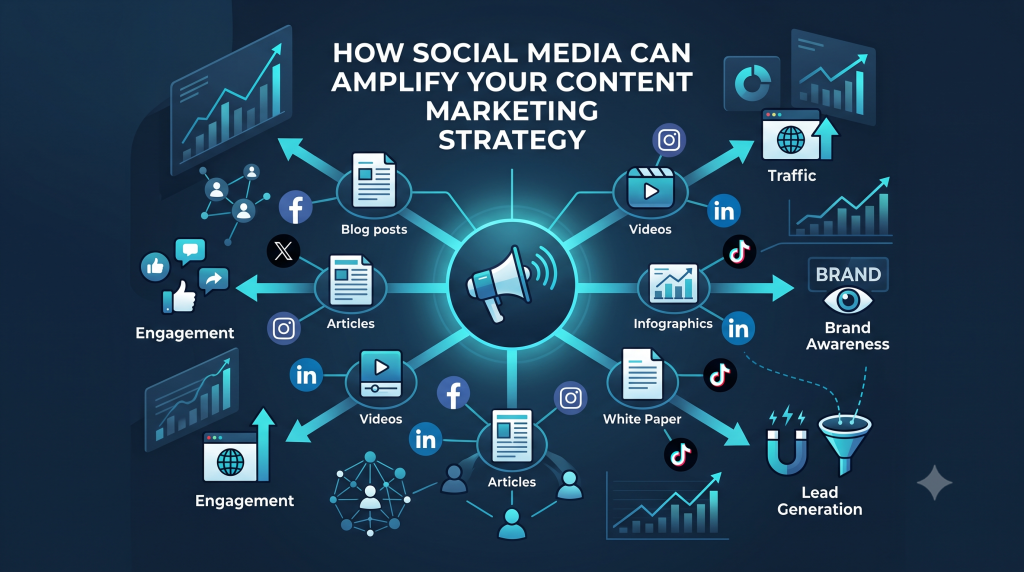
Content amplification is the process of increasing the reach, visibility, and engagement of a piece of content beyond its original audience. It includes both organic methods (sharing on social media, email newsletters, community engagement) and paid methods (promoted posts, sponsored placements, display ads).
Publishing content alone rarely produces meaningful results. A blog post on a new website might reach a few dozen people. The same post distributed across relevant social channels, email, and communities can reach thousands — often without paid spend.
Social media sits at the centre of most amplification strategies because it offers direct access to audiences, encourages sharing, and provides feedback loops that inform future content.
Organic vs Paid Amplification
- Organic: You share content on your own channels, employees share it, community members share it, you participate in relevant groups.
- Paid: You boost posts, run sponsored content, or use platform ad tools to reach broader or more targeted audiences.
Most effective strategies use both. Organic builds credibility and community. Paid extends reach when you need it.
How Social Media and Content Marketing Work Together
Social media and content marketing are often treated as separate departments, but they’re most effective as a single cycle:
Create → Repurpose → Distribute → Engage → Measure → Improve
Here’s how that looks in practice:
- Content creation — You produce a valuable asset: a blog post, video, guide, or case study.
- Content distribution — You share it where your audience spends time.
- Audience engagement — People comment, ask questions, share, and save.
- Community building — Repeated interaction turns casual readers into familiar faces.
- Traffic generation — Engaged users click through to your website.
- Feedback — Comments and questions reveal what your audience cares about.
- Lead generation — Educational content moves people toward a next step.
- Conversion support — Content builds trust before a purchase or enquiry.
The cycle repeats. Engagement insights feed back into content creation. High-performing topics become future content pillars. Questions asked in comments become FAQ sections or dedicated posts.
This is what a connected content ecosystem looks like. Neither channel works as well alone.
10 Ways Social Media Can Amplify Your Content Marketing Strategy
1. Expand Content Reach
Social platforms expose your content to people who would never find it through search alone — at least not yet. A new blog post might take weeks or months to rank. A social post can reach your audience within minutes.
Each platform has its own discovery mechanics. LinkedIn surfaces content through network activity and interest signals. Instagram and TikTok use interest-based recommendation systems. Pinterest functions more like a visual search engine.
Reach isn’t just about follower count. A small, engaged audience can drive more meaningful traffic than a large, passive one.
2. Drive Traffic to Valuable Content
Social media is a bridge between where people spend time and the deeper content you want them to read.
Effective social posts don’t just say “read our new blog.” They give a reason. Share a specific insight, pose a question, or highlight a common problem the content solves. Then link to:
- Blog posts
- Landing pages
- Guides and ebooks
- Case studies
- Product pages
- Resource libraries
The goal is to make the click feel like a natural next step, not an advertisement.
3. Repurpose Long-Form Content
One well-researched article can become dozens of social assets. This is where content repurposing pays off.
A 2,000-word blog post might become:
- A LinkedIn text post summarising the main argument
- An Instagram carousel breaking down key points
- Two or three short videos explaining individual concepts
- An infographic visualising the data
- Several short posts pulling out individual tips
- A poll or question based on a debated point
- An email newsletter section
Practical example: A service business publishes a guide called “5 Signs Your Website Needs a Redesign.” From that one guide, they create a LinkedIn carousel with one sign per slide, a 60-second video walking through sign #1, three X posts each highlighting a single sign, and a poll asking “When did you last update your website?” Each asset links back to the full guide.
4. Increase Audience Engagement
Comments, shares, saves, and reactions extend the life of content. A post with active discussion gets shown to more people — not just because of algorithms, but because engagement signals genuine relevance.
Saves are particularly valuable. When someone saves a post, they’re signalling intent to return to it. That’s a stronger signal than a like.
Reply to comments. Ask follow-up questions. Acknowledge different perspectives. Engagement isn’t just a metric; it’s a conversation that keeps content alive longer.
5. Generate Content Ideas From Audience Feedback
Your audience tells you what they want to read — if you listen.
Comments often contain questions that could become:
- FAQ sections
- Dedicated blog posts
- Video topics
- Webinar themes
Polls reveal which subtopics interest people most. Direct messages can highlight confusion about a specific process. Community discussions surface pain points you might not have considered.
Keep a running document of audience questions. Review it monthly. Patterns emerge quickly.
6. Build Brand Authority
Consistently publishing useful content on social media contributes to how people perceive your expertise. This isn’t about claiming to be an authority — it’s about demonstrating it repeatedly.
When a business answers questions clearly, shares practical insights, and avoids overt selling, trust builds over time. People remember who helped them before they needed to buy.
Note: Social signals like shares and likes are not direct Google ranking factors. Google’s own documentation does not list social engagement as a ranking signal. However, social media can indirectly support SEO by increasing brand searches, earning links, and driving traffic that signals relevance.
7. Create Community Around Content
Content marketing isn’t only about attracting new readers. It’s also about turning casual readers into a community that returns.
Community forms when:
- People recognise your brand voice
- They see others engaging with your content
- You respond consistently
- There’s a shared interest or challenge
A community doesn’t require a group or forum. It can be as simple as a LinkedIn page where discussions regularly happen, or an Instagram account where followers reply to stories.
8. Strengthen Content Distribution
Social media should be treated as a distribution channel, not a promotional afterthought.
A distribution mindset means:
- Planning how each piece of content will be shared before you publish
- Adapting formats for each platform
- Scheduling posts across multiple days
- Re-sharing evergreen content periodically
This is different from posting promotional links. Distribution is about making sure valuable content actually reaches the people it was made for.
9. Support Lead Generation
Educational content on social media can move people from awareness to action without aggressive selling.
The journey often looks like:
- Someone sees a helpful post
- They visit your website for more
- They subscribe to a newsletter or download a resource
- They return when they have a need
- They enquire or purchase
Not every post needs a call to action. But over time, consistent value creates a pathway. The key is making the next step easy and relevant — newsletter signup, free download, consultation booking.
10. Use Performance Data to Improve Future Content
Social analytics reveal more than which posts got likes. They show:
- Topics people engage with
- Formats that perform well (carousels vs. video vs. text)
- Questions audiences ask repeatedly
- Content people share
- Content people save
- Audience preferences by platform
These insights should influence future content creation. If carousels consistently outperform single images, make more carousels. If one topic generates more saves than anything else, create a deeper piece on that topic.
How to Repurpose One Blog Into Multiple Social Media Content Pieces
The principle is simple: Create once → Adapt intelligently → Distribute everywhere relevant.
Here’s a practical breakdown using a hypothetical 2,000-word blog post titled “How to Choose the Right Digital Marketing Channel for Your Business”:
| Asset | Platform | Adaptation |
|---|---|---|
| 1 LinkedIn post | 150-word summary of the main framework, ending with a question | |
| 1 Instagram carousel | 7 slides, one per channel type, with a CTA on the final slide | |
| 2–3 short videos | Reels, TikTok, Shorts | Each video covers one channel type in 45–60 seconds |
| 1 infographic | Pinterest, LinkedIn | Visual comparison of channel strengths and limitations |
| 3–5 short posts | X, Facebook | Individual tips or statistics pulled from the article |
| 1 email newsletter | Short introduction plus link to full article | |
| 1 poll | LinkedIn, IG Stories | "Which marketing channel works best for your business?" |
| 1 FAQ post | IG Stories, LinkedIn | Answer a common question from the comments |
Important: Don’t copy-paste identical content across every platform. A LinkedIn audience expects a different tone and format than an Instagram audience. Adapt the message to the platform’s culture and user behaviour.
Social Media Content Strategy by Platform
| Platform | Suitable Content | Main Objective | Example |
|---|---|---|---|
| Carousels, Reels, Stories, static images | Brand awareness, engagement | Educational carousel on a common industry mistake | |
| Links, images, videos, community posts | Traffic, community, engagement | Blog link with a strong excerpt | |
| Text posts, documents, articles, videos | Authority, B2B leads, engagement | Insight post with a question at the end | |
| YouTube | Long-form video, Shorts | Education, search visibility | Tutorial or explainer video |
| X | Short text, threads, images | Real-time engagement, conversation | Thread breaking down a process |
| Infographics, visual guides, pins | Traffic, discovery | Step-by-step visual guide | |
| TikTok | Short video, trends, educational clips | Awareness, reach | Quick tip in under 60 seconds |
Not every business needs every platform. Choose based on where your audience spends time, what format suits your content, and what resources you can sustain.
How to Build a Social Media Content Distribution Workflow
- Create the core content — Blog post, video, guide, or case study
- Identify key insights — Pull out the 3–5 most useful points
- Extract important statistics or facts — Any data worth highlighting
- Create platform-specific content — Adapt format and tone for each channel
- Schedule and publish — Use a scheduling tool or post manually
- Engage with the audience — Reply to comments, answer questions
- Monitor performance — Track reach, engagement, traffic, conversions
- Repurpose successful content — If something performs well, create more like it
- Update the original content when necessary — Keep it accurate and current
- Repeat the cycle — Consistency compounds
For a small business, this might mean one core piece of content per week and 3–5 social posts derived from it. That’s manageable.
How to Create a Social Media Content Calendar
A content calendar doesn’t need to be complicated. Here’s a realistic weekly example for a small business:
| Day | Platform | Content Type | Topic | CTA | Objective |
|---|---|---|---|---|---|
| Monday | Text post | Industry insight from blog | Read full article | Traffic | |
| Tuesday | Carousel | Key points from blog | Save for later | Engagement | |
| Wednesday | Link post | Blog article | Read more | Traffic | |
| Thursday | IG Stories | Poll | Question related to topic | Vote | Engagement |
| Friday | Video | Quick tip from blog | Follow for more | Awareness | |
| Saturday | Infographic | Visual summary | Visit website | Traffic | |
| Sunday | — | — | — | — | Rest |
This is a guide, not a rule. Posting every day isn’t necessary. Consistency matters more than frequency.
How to Measure the Impact of Social Media on Content Marketing
The right metrics depend on your objective.
Awareness Metrics
- Reach
- Impressions
- Video views
Engagement Metrics
- Comments
- Shares
- Saves
- Engagement rate
Traffic Metrics
- Website sessions from social
- Referral traffic
- Click-through rate
Conversion Metrics
- Leads
- Sign-ups
- Enquiries
- Purchases
- Conversion rate
Content Metrics
- Top-performing topics
- Top-performing formats
- Content retention
- Returning visitors
Vanity metrics alone don’t prove business success. A post with 10,000 impressions but no meaningful engagement or traffic is less valuable than a post with 500 impressions that generates 20 qualified website visits.
Common Social Media Content Marketing Mistakes
| Mistake | Solution |
|---|---|
| Posting without a strategy | Define objectives, audience, and content pillars first |
| Promoting every post aggressively | Follow the 80/20 rule: 80% value, 20% promotion |
| Creating platform-identical content | Adapt format and tone for each platform |
| Ignoring audience comments | Set aside time daily to respond and engage |
| Focusing only on follower count | Track engagement, traffic, and conversions instead |
| Not repurposing valuable content | Create a repurposing workflow for every major piece |
| Posting inconsistently | Use a calendar and schedule posts in advance |
| Ignoring analytics | Review performance monthly and adjust |
| Choosing platforms without understanding the audience | Research where your audience actually spends time |
| Creating content without a clear purpose | Define the goal for each post before creating it |
| Using trends that are irrelevant to the brand | Only participate in trends that align with your message |
| Measuring likes instead of business outcomes | Align metrics with business objectives |
Social Media vs Content Marketing: Are They the Same?
No. They overlap, but they’re not identical.
Content marketing is the broader strategy of creating and distributing valuable, relevant content to attract and retain an audience. It includes blogs, videos, podcasts, guides, email newsletters, and more.
Social media marketing is a channel and set of tactics used to distribute content, engage audiences, build communities, and achieve marketing objectives.
Content marketing provides the substance. Social media provides the distribution and conversation layer. You can do social media without content marketing (though it’s harder to sustain), but content marketing without distribution — including social media — limits its reach.
How AI Can Support Social Media and Content Marketing
AI tools can speed up certain tasks, but they don’t replace strategy, judgment, or brand voice.
Practical use cases:
- Topic research — Identifying questions and trends
- Content ideation — Generating angles or outlines
- Content repurposing — Adapting one format into another
- Caption drafting — Creating initial versions for editing
- Content briefs — Structuring briefs for writers
- Social post variations — Generating multiple options for A/B testing
- Audience insight analysis — Summarising comment themes
- Content calendars — Suggesting posting schedules
- Performance analysis — Highlighting patterns in data
What AI should not do: replace human review, fact-checking, original insight, or authentic brand voice. AI-generated content without human editing often reads as generic and can contain inaccuracies. Use AI as an assistant, not an author.
Best Practices for Amplifying Content on Social Media
- Start with genuinely useful content
- Understand your audience before choosing platforms
- Adapt content to each platform's format and culture
- Use strong hooks in the first line or first three seconds
- Make content easy to consume (short paragraphs, clear visuals)
- Encourage meaningful engagement, not just likes
- Use relevant CTAs
- Repurpose evergreen content regularly
- Monitor analytics and adjust
- Double down on proven topics
- Maintain consistency over intensity
- Prioritise quality over volume
Frequently Asked Questions
1. How does social media support content marketing?
Social media distributes content to audiences beyond your website, encourages engagement, provides feedback for future content, and supports traffic, leads, and brand awareness. It acts as the distribution and conversation layer of a broader content marketing strategy.
2. Why is social media important for content distribution?
Publishing content alone rarely reaches enough people. Social media offers direct access to audiences, encourages sharing, and can drive immediate traffic while search rankings develop. It’s one of the fastest ways to get content in front of the right people.
3. Can social media increase blog traffic?
Yes. When content is shared effectively on relevant platforms, it can drive referral traffic, especially in the early stages before search rankings build. The key is sharing content that’s genuinely useful and adapted to each platform, not just posting links.
4. How can I repurpose blog content for social media?
Pull out key insights, statistics, and quotes. Turn them into carousels, short videos, text posts, infographics, polls, and email sections. Adapt the format and tone for each platform rather than copying and pasting identical content everywhere.
5. Which social media platform is best for content marketing?
There’s no single best platform. It depends on your audience, industry, content format, and goals. B2B businesses often see strong results on LinkedIn. Visual brands perform well on Instagram and Pinterest. Video-first content suits YouTube and TikTok. Choose based on where your audience spends time.
6. How often should businesses share content on social media?
Consistency matters more than frequency. A realistic schedule for many small businesses is 3–5 posts per week, with at least one piece of core content promoted across platforms. Posting daily isn’t necessary if the quality suffers.
7. What type of content performs best on social media?
Content that’s useful, easy to consume, and relevant to the audience. Formats vary by platform: carousels and Reels on Instagram, text posts and documents on LinkedIn, short video on TikTok. Questions, tips, and practical insights tend to perform well across most platforms.
8. How do you measure content amplification?
Track reach, impressions, engagement (comments, shares, saves), referral traffic, click-through rate, and conversions. The right metrics depend on your objective. Awareness campaigns focus on reach; lead generation focuses on conversions.
9. Does social media directly improve SEO rankings?
Social signals are not a direct Google ranking factor. However, social media can indirectly support SEO by increasing brand awareness, earning links, driving traffic, and helping content get discovered. Google’s documentation does not list social engagement as a ranking signal.
10. How can small businesses use social media for content marketing?
Start with one or two platforms where your audience is active. Create one core piece of content per week and adapt it into 3–5 social posts. Engage with comments, monitor what performs well, and adjust. Consistency and quality matter more than volume.
11. Should every blog post be promoted on social media?
Not necessarily. Promote content that’s genuinely useful and relevant to your social audience. Some posts may be better suited for email or search. Prioritise quality over quantity — sharing fewer, better posts is more effective than sharing everything.
12. Can AI help with social media content marketing?
Yes, AI can assist with topic research, content ideation, repurposing, caption drafting, and performance analysis. However, human review is essential for accuracy, brand voice, and original insight. AI should support your strategy, not replace it.
Conclusion
Creating valuable content is only half the work. The other half is making sure it reaches the people it was created for.
Social media and content marketing work best when they’re treated as a connected system: create, repurpose, distribute, engage, measure, and improve. This cycle compounds over time. Each piece of content strengthens the next. Each engagement teaches you something about your audience.
You don’t need to be on every platform. You don’t need to post every day. You need a repeatable process that gets your best content in front of the right people and turns their responses into better content.
Start by reviewing your current content strategy. Are you creating valuable content that no one sees? Are you sharing it where your audience actually spends time? Is there a feedback loop between what you publish and what you learn?
Need help building a content distribution system?
We work with businesses to develop social media and content marketing strategies that are practical, measurable, and built around their audience.