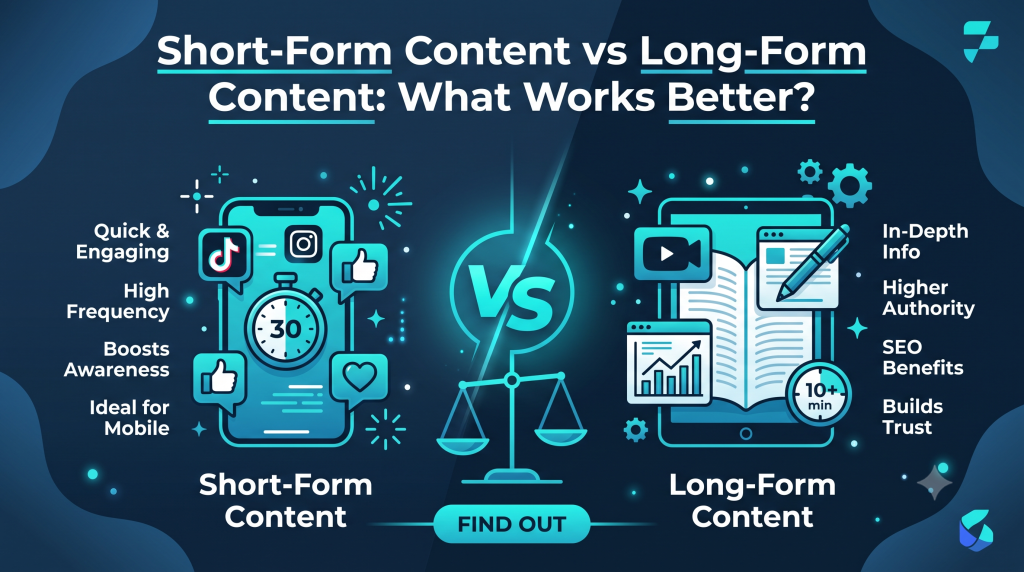
Quick answer: Neither format is universally better. Short-form content wins attention, reach, and frequency. Long-form content wins depth, trust, search visibility, and education. The right choice depends on your audience, platform, objective, topic complexity, and funnel stage — not on a word count.
Ask ten marketers whether short-form or long-form content performs better and you will get ten confident answers — many of them contradicting each other. One points to a viral Reel that generated thousands of profile visits. Another points to a 4,000-word guide that quietly brings in qualified leads every month.
Both are right. And both are wrong, because the question is being asked in the wrong way.
The real question is not which format is better. It is: which format is better for this audience, on this platform, for this objective, at this stage of the journey?
That is what this article answers. You will learn what short-form and long-form content actually are, how they differ, what each does well, where each falls short, how they perform in search and on social media, and how to build a content strategy that uses both instead of treating them as competitors.
If you have ever wondered whether long-form content still ranks, whether short-form video is worth the effort, or whether your business should double down on one format, you will leave with a practical framework rather than a slogan.
What Is Short-Form Content?
Short-form content is any content designed to be consumed in seconds rather than minutes. In practice, that usually means video under 60 seconds and written content under roughly 300 words — though there is no official industry threshold, and the line keeps shifting as platforms change.
What defines short-form content is not just length. It is intent: one idea, delivered fast, with the hook up front and no expectation that the viewer will stay long.
Common characteristics of short-form content
- Built around a single idea or takeaway
- Front-loaded hook in the first one to three seconds
- Mobile-first, vertical, and platform-native in design
- Low commitment for the viewer — easy to scroll past
- Optimised for repetition and frequent publishing
- Often designed to be saved, shared, or commented on quickly
Short-form content examples
- Instagram Reels and Stories
- YouTube Shorts
- TikTok videos
- Short LinkedIn posts and text-only insights
- Quick tips, hot takes, and micro-tutorials
- Memes and relatable industry humour
- Short promotional clips and product teasers
- Brief email content and SMS-style updates
- Instagram and LinkedIn carousels with one point per slide
When short-form content is most useful
Short-form content works best when you need attention quickly, when the idea can be communicated in a few seconds, when your audience is mobile-first, or when you are testing which messages resonate before investing in bigger assets.
It is also the natural format for social distribution, where reach is driven by how many people stop, watch, and share — not by how much you wrote.
What Is Long-Form Content?
Long-form content is content that goes deep enough to fully answer a complex question. In practice, that often means articles over 1,500 words, videos over 10 minutes, or multi-page resources such as guides and reports — but again, there is no universally accepted word-count threshold that applies across every format.
A 900-word article that completely resolves a specific question can be long-form in spirit. A 3,000-word article that repeats itself is not. Length is the packaging; depth is the product.
Common characteristics of long-form content
- Covers a topic in depth, including nuance and exceptions
- Answers multiple related questions in one place
- Usually supported by research, examples, or original insight
- Structured with clear headings, subheadings, and navigation
- Designed to be referenced, linked to, and returned to
- Often used to demonstrate expertise and build topical authority
Long-form content examples
- Comprehensive blog posts and pillar pages
- In-depth guides and tutorials
- Case studies and customer stories
- White papers and research reports
- Ebooks and downloadable resources
- Long-form YouTube videos, webinars, and podcasts
- Detailed product and service pages
- Original research and data studies
When long-form content is most useful
Long-form content earns its place when the topic is complex, when the reader needs to make a considered decision, when search intent demands a thorough answer, or when you want to build a resource that keeps working for months or years.
It is also the format that gives search engines and AI answer systems enough substance to understand what your page is genuinely about.
Benefits of Short-Form Content
Short-form content is not simply the easier option. When used deliberately, it solves specific problems that long-form content solves poorly.
- Fast consumption. A viewer can absorb the full message in seconds, which removes the biggest barrier to engagement.
- Easy distribution. One short video can be published natively across multiple platforms with minimal adaptation.
- Strong social media compatibility. Most major platforms now prioritise short video and quick, scannable posts in their feeds.
- Rapid feedback. You learn what resonates within days rather than months, which makes it a cheap testing ground for messaging.
- Efficient for awareness. Short content is well suited to reaching people who have never heard of your brand.
- Mobile-first by default. Vertical video and short text fit how most audiences actually consume content today.
- Easy repurposing. A single long-form asset can generate many short-form pieces.
- Lower barrier to entry. You do not need a production budget to publish something useful.
Limitations of Short-Form Content
Short-form has real limits, and ignoring them leads to strategy that looks busy but does not build anything.
- Limited depth. Complex topics get flattened or oversimplified, which can mislead an audience.
- Little room for explanation. There is rarely space to address exceptions, context, or trade-offs.
- Hard to cover complex subjects. Regulated industries, technical products, and nuanced advice rarely fit into 45 seconds.
- Shorter content lifespan on many platforms. Feed-based content often stops being discovered within days.
- High publishing pressure. Visibility usually depends on consistency, which is demanding to sustain.
- May not satisfy complex informational intent. Someone researching a major purchase usually needs more than a clip.
Results vary by audience, platform, industry, and content objective — so treat these as tendencies, not laws.
Benefits of Long-Form Content
Long-form content does something short-form content cannot: it builds a body of knowledge that compounds over time.
- Greater topical depth. You can cover a subject properly, including the parts competitors skip.
- Answers many questions at once. One strong guide can satisfy dozens of related search queries.
- Strong educational value. Frameworks, processes, and comparisons need room to breathe.
- Demonstrates expertise. Depth is one of the clearest signals of genuine experience with a subject.
- Supports complex search intent. When someone needs a real answer, a thorough page is the only thing that satisfies them.
- Builds topical authority. Interlinked long-form resources help search engines understand your site’s focus.
- Better internal linking environment. Detailed pages create natural opportunities to connect related content.
- Stronger resource value. People bookmark, cite, and return to genuinely useful guides.
- Supports lead generation. Detailed content is the natural place to offer a download, demo, or consultation.
Limitations of Long-Form Content
Long-form content fails often — usually for predictable reasons.
- Higher production effort. Research, writing, editing, design, and fact-checking all take time.
- Longer research cycle. Accuracy requires verification, which slows publishing.
- Greater editing demands. Weak structure is far more damaging at 3,000 words than at 300.
- Risk of filler. Padding to hit a word count destroys trust and readability.
- Lower readability if poorly structured. Dense walls of text lose readers regardless of quality.
- Weak introductions lose people immediately. Readers decide within seconds whether to stay.
- No guarantees. Long content does not automatically rank, convert, or get shared.
Depth matters more than arbitrary word count. A focused 1,200-word article that fully answers a question will outperform a 3,000-word article that circles it.

Does Long-Form Content Rank Better on Google?
No — not automatically. Google does not reward content simply because it is longer. Length is a byproduct of covering a topic well, not a ranking factor in itself.
What actually influences search performance includes:
- Relevance — does the page match what the searcher is looking for?
- Search intent — is it answering a question, comparing options, or helping someone buy?
- Content quality — is it accurate, clear, and genuinely useful?
- Helpful information — does it offer something beyond what already exists?
- Experience and expertise — is it written by someone who clearly knows the subject?
- Technical SEO — is the page fast, crawlable, mobile-friendly, and indexable?
- Internal linking and site structure — does the page connect to a wider topical cluster?
- Originality and usefulness — does it add real value rather than restating the obvious?
There are short pages that rank first for a query because they answer it perfectly, and long pages that never rank because they answer nothing. Google’s own guidance for creating helpful, reliable, people-first content focuses on usefulness and expertise — not on hitting a word count.
The practical takeaway: write until the question is fully answered, then stop.
Is Short-Form Content Better for Social Media?
Often yes for reach — but not universally. Short-form formats tend to perform well on platforms where people scroll quickly and decide in under two seconds whether to keep watching.
Platforms such as Instagram Reels, YouTube Shorts, TikTok, and short LinkedIn posts are built around fast consumption and are distributed through recommendation feeds rather than follower counts alone. That makes them effective for discovery.
But short-form is not automatically superior. Longer LinkedIn posts and YouTube videos can build far more trust. Carousels can outperform video for educational content. Platform behaviour, audience expectations, content type, and objective all shape what works.
The honest answer: match the format to the platform’s native behaviour, then test.
Short-Form vs Long-Form Content for Different Marketing Goals
Format decisions become much simpler once you start from the goal rather than the trend.
Brand Awareness
Short-form content usually has the edge because it reaches new audiences through recommendation feeds. Long-form can build awareness too, but typically through search visibility and referrals rather than volume.
Engagement
Short-form tends to generate more interactions — likes, comments, shares, and saves — because the barrier to responding is low. Long-form generates fewer but deeper interactions, often including comments that indicate genuine intent.
SEO
Long-form content still carries most of the weight for organic search because it can satisfy detailed intent and support topical clusters. Short-form contributes through video search, social search, and by feeding ideas into your SEO pipeline.
Lead Generation
Both can generate leads. Short-form works when the offer is simple and the friction is low. Long-form works better when trust must be built first — gated guides, detailed comparisons, and case studies typically outperform clips for considered purchases.
Thought Leadership
Detailed content is usually more effective here. Strong opinions backed by evidence, original frameworks, and well-argued long posts demonstrate expertise in a way that short clips rarely can.
Product Education
Long-form content is generally more appropriate for products that need explaining — how something works, who it is for, and how it compares to alternatives. Short-form is better for showing a single feature or benefit in action.
Social Media Growth
Short-form content contributes most directly to follower growth because platforms favour it in discovery. Consistent, useful short videos remain one of the fastest ways to reach new people.
Conversions
Format alone does not determine conversion performance. Offer clarity, audience fit, page experience, and trust signals matter far more than whether the content is 30 seconds or 3,000 words.
Short-Form vs Long-Form Content Across the Marketing Funnel
| Funnel Stage | Short-Form Content | Long-Form Content |
|---|---|---|
| Awareness | Primary driver — reels, shorts, TikToks, quick tips that reach new audiences | Secondary — SEO articles and videos that capture people already searching |
| Consideration | Supporting — comparison clips, feature demos, objection-handling snippets | Primary driver — buying guides, comparisons, tutorials, case studies |
| Decision | Supporting — testimonials, quick proof points, retargeting creative | Primary driver — detailed service pages, pricing explanations, in-depth case studies |
| Retention | Supporting — tips, updates, community content, product reminders | Primary driver — knowledge bases, advanced guides, onboarding resources |

Which Is Better for SEO?
It depends on the query — not on the word count. SEO performance is driven by search intent, relevance, content quality, topic coverage, internal linking, technical SEO, user experience, original information, and demonstrated expertise, authority, and trust.
Where long-form content genuinely helps SEO:
- Covering broad topics that require multiple sub-answers
- Targeting high-intent research queries
- Supporting pillar-and-cluster structures
- Earning links and citations as a reference resource
Where short-form content helps SEO:
- Video search on YouTube and Google
- Social search on TikTok and Instagram
- Supporting brand queries and entity recognition
- Driving engagement signals that strengthen overall brand presence
The clearest rule: longer does not automatically mean better SEO. Match the depth to the question.
Which Is Better for Social Media?
Different platforms reward different behaviours, so a single answer would be misleading.
- Short-form video dominates discovery on TikTok, Reels, and Shorts.
- Carousels often outperform video for educational and step-by-step content on Instagram and LinkedIn.
- Short text posts work well on X and LinkedIn for opinions and observations.
- Stories are better for behind-the-scenes content and community interaction.
- Longer LinkedIn posts can perform strongly when they tell a specific story or share a real lesson.
- Captions matter more than most people assume — they extend dwell time and add context.
Study the platform’s native behaviour before deciding on a format.
Which Is Better for Businesses?
There is no universal answer, and any agency that gives you one should be questioned. The right mix depends on your business objective, audience, platform, topic, available resources, funnel stage, conversion goal, and distribution strategy.
A local plumber, a B2B software company, and a fashion e-commerce brand should not run identical content strategies — even if they all operate online.
The most reliable approach is a balanced content ecosystem: short-form content to attract attention, long-form content to build trust and capture demand, and a repurposing workflow connecting the two.
Why the Best Strategy Combines Short-Form and Long-Form Content
Treating these formats as competitors is the most common strategic mistake in content marketing. They do different jobs, and the strongest strategies use both.
Short-form content creates the first touch. Long-form content converts that attention into understanding, and understanding into trust. Without short-form, your long-form content may never be discovered. Without long-form, the attention short-form generates has nowhere to go.
This is where content repurposing becomes the highest-leverage activity in your workflow. One comprehensive article can become:
- Three to five social media posts, each covering one section
- Multiple short videos built around individual insights
- Several LinkedIn posts with a distinct angle from the same research
- An Instagram or LinkedIn carousel summarising the framework
- An email newsletter edition
- Short educational clips for YouTube Shorts or Reels
- FAQ content answering the questions readers actually asked
- Social graphics featuring key statistics or quotes
This is not about volume for its own sake. It is about extracting maximum value from research you have already done.
Content Repurposing Workflow
A repeatable workflow removes the guesswork. Here is one that works for most teams:
- Research — Identify the questions your audience is actually asking, using search data, sales conversations, comments, and support tickets.
- Long-form content — Build one comprehensive asset that answers the core question thoroughly and accurately.
- Key insights — Pull out the standalone ideas, statistics, frameworks, and quotes worth sharing individually.
- Short-form content — Turn each insight into a native short-form asset for the platform it fits best.
- Distribution — Publish across search, social, email, and owned channels rather than relying on one.
- Engagement — Respond to comments and questions, and note what people ask next.
- Optimisation — Update the long-form asset with new questions, refresh underperforming sections, and repeat the cycle.
How to Choose Between Short-Form and Long-Form Content
Work through these ten questions before you start creating. They will resolve most format debates in under five minutes.
- What is the goal? Awareness, education, lead generation, or retention?
- Who is the audience? How do they prefer to consume content, and where do they spend time?
- Which platform will distribute it? Each platform has native behaviours and formats.
- How complex is the topic? Can it be explained in one idea, or does it need layers?
- What does the audience need right now? A quick answer, or a full understanding?
- What stage of the funnel are they in? Awareness and consideration demand different depths.
- Is the topic informational or promotional? Promotional ideas often work best short; informational ones often need room.
- Can the idea be explained quickly? If yes, short-form is usually the better first move.
- Does the subject require evidence or detailed explanation? If yes, go long.
- Can the content be repurposed? If it can feed other formats, long-form often delivers more total value.
Practical Examples
The following are illustrative examples, not documented case studies.
Example 1: Local Business
A dental clinic might publish short videos answering common patient questions — whitening myths, what a check-up involves, how to handle sensitivity. Those clips build local awareness and reach people who are not actively searching. Meanwhile, detailed service pages and blog articles about procedures, costs, and aftercare capture people who are actively comparing providers.
Example 2: E-commerce Brand
A home fitness brand could use short-form product videos to create attention and demonstrate equipment in use, then support that attention with detailed buying guides, comparison articles, and setup tutorials. The short content creates desire; the long content removes doubt.
Example 3: B2B Company
A B2B software company can use short LinkedIn posts to share quick insights, industry observations, and product tips that build visibility among decision-makers. Detailed guides, technical documentation, case studies, and research reports then support the longer evaluation cycle that B2B purchases require.
Common Content Strategy Mistakes
- Choosing length based on trends. Format should follow strategy, not the other way around.
- Writing long articles filled with fluff. Padding dilutes authority and loses readers.
- Creating short content without substance. A 30-second video with nothing to say builds nothing.
- Ignoring search intent. A beautifully written page that answers the wrong question will not perform.
- Creating content only for algorithms. Optimising for distribution while ignoring the reader rarely works long term.
- Publishing without distribution. Content that is not promoted is not really published.
- Ignoring audience behaviour. Assuming your audience wants long reads — or short clips — without checking is a costly assumption.
- Focusing on quantity over usefulness. Ten forgettable posts rarely outperform one genuinely helpful resource.
- Failing to repurpose valuable content. Most teams leave significant value on the table.
- Not measuring business outcomes. Views and traffic mean little if they never connect to revenue.
How to Measure Content Performance
The right metrics depend on what the content was created to do. Measuring a brand awareness video by lead volume, or a lead generation guide by views, produces misleading conclusions.
| Content Type | Useful Metrics |
|---|---|
| Short-form content | Views, watch time, completion rate, engagement rate, shares, saves, comments, profile visits, click-throughs |
| Long-form content | Organic traffic, engaged sessions, scroll depth where available, internal link clicks, leads, conversions, assisted conversions, backlinks, returning visitors |
One metric is never universally superior. A video with 100,000 views and no business impact is not outperforming an article with 800 views that generates twenty qualified enquiries.
Set the objective first, then choose the metric that proves it.
Short-Form Content vs Long-Form Content: Which Should You Choose?
Choose short-form content when:
- You need quick attention from a new audience
- The idea can be communicated in seconds
- Social distribution is your priority
- You want to test which messages resonate before investing more
- You are building awareness at the top of the funnel
Choose long-form content when:
- The topic is complex or requires nuance
- Users need detailed information before deciding
- You want to build a comprehensive, linkable resource
- Search intent requires depth and completeness
- You are creating educational, research-driven, or authority-building content
In many cases, the strongest strategy is to use both. Short-form content earns attention. Long-form content earns trust. Together they move people from stranger to customer.
The Attract → Educate → Engage → Convert → Retain Framework
Use this five-stage framework to decide where each format earns its place in your content strategy.
- Attract — mostly short-form. Reels, Shorts, TikToks, and short posts reach new audiences and create first impressions.
- Educate — mostly long-form. Guides, tutorials, comparisons, and detailed videos explain how your solution works and why it matters.
- Engage — both. Short content invites quick interaction; long content invites discussion, comments, and community participation.
- Convert — mostly long-form with short support. Detailed pages, case studies, and demos do the heavy lifting, supported by short proof-point content and testimonials.
- Retain — both. Short-form keeps you present between purchases; long-form knowledge bases and advanced guides deepen the relationship.
The formats are not competing for the same job. They are collaborating on different ones.
Frequently Asked Questions
What is the difference between short-form and long-form content?
Short-form content is designed to be consumed in seconds — typically video under 60 seconds and text under roughly 300 words. Long-form content goes deep enough to fully answer a complex question, often 1,500+ words for articles or 10+ minutes for video. There is no official threshold for either.
Is short-form content better than long-form content?
Neither is universally better. Short-form content performs better for reach, awareness, and rapid engagement. Long-form content performs better for depth, education, search visibility, and considered purchases. The right choice depends on your audience, platform, objective, and funnel stage.
Is long-form content better for SEO?
Not automatically. Google does not reward length by itself. Long-form content often performs well because it covers a topic thoroughly and satisfies detailed search intent — but relevance, quality, expertise, technical SEO, and internal linking matter more than word count.
Is short-form content better for social media?
Often for reach, yes — platforms like TikTok, Instagram Reels, and YouTube Shorts prioritise short video in discovery. But longer LinkedIn posts, carousels, and educational videos can outperform short clips for trust and engagement. Platform behaviour and audience expectations decide.
How long should a long-form blog post be?
Long enough to fully answer the question and no longer. Many effective long-form articles fall between 1,500 and 3,000 words, but topic complexity matters more than a target number. Depth and usefulness beat arbitrary word counts.
How short should short-form content be?
Short enough to hold attention without losing the point. For video, that is usually 15 to 60 seconds. For written content, under roughly 300 words. The test is whether the idea lands before attention drops.
Can short-form content improve brand awareness?
Yes. Short-form content is one of the most effective formats for reaching new audiences because recommendation feeds distribute it beyond your existing followers. Results vary by platform, niche, and consistency.
Can long-form content generate leads?
Yes. Long-form content builds the trust required for considered purchases and is a natural fit for gated resources, detailed service pages, case studies, and comparison guides. It often converts fewer people at a higher quality.
Should businesses use both short-form and long-form content?
In most cases, yes. Short-form content attracts attention and drives discovery; long-form content educates, builds authority, and supports conversion. Using both creates a stronger system than relying on either alone.
How can I turn long-form content into short-form content?
Break the long-form asset into individual insights. Each section, statistic, framework, or quote can become a short video, a social post, a carousel slide, an email snippet, or a graphic. Start with the strongest single idea, not the whole article.
Final Thoughts
Short-form content and long-form content should not be treated as competing formats. They perform different jobs within the same strategy.
Short-form content earns attention in a crowded feed. Long-form content earns trust in a considered decision. The businesses that win at content marketing are rarely the ones that picked a side — they are the ones that built a system where each format feeds the other.
Choose your format based on your audience, their intent, the platform you are publishing on, your objective, the complexity of the topic, the funnel stage, and your business goals. Then measure what actually happened, and adjust.
Useful information will always outperform arbitrary word count. Search intent will always outperform keyword density. And depth and relevance will always outperform content length.
Ready to Build a Content Strategy That Uses Both?
Stop guessing whether your next asset should be a 30-second clip or a 3,000-word guide. Get a content plan built around your audience, your funnel, and your business goals.