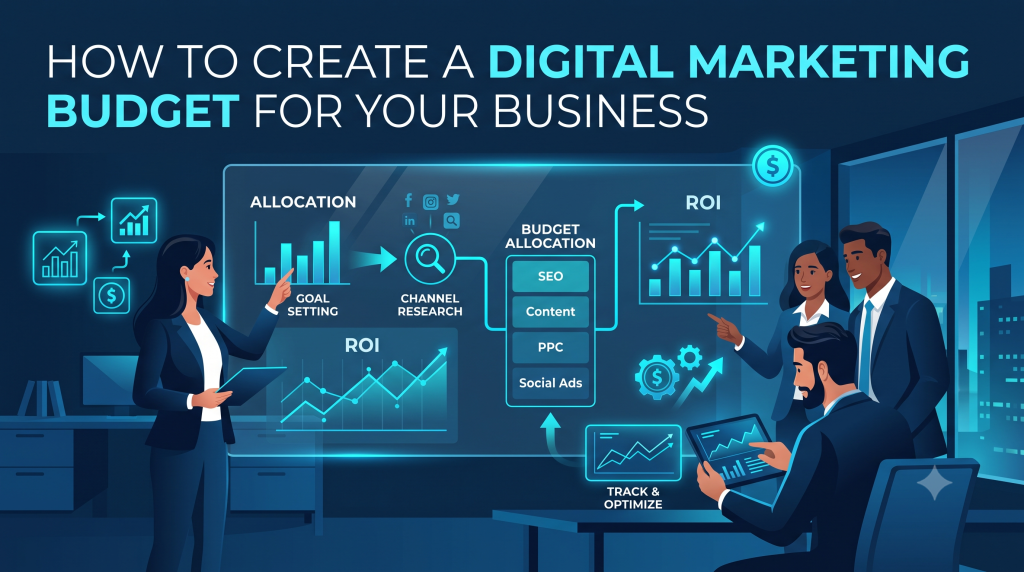
What Is a Digital Marketing Budget?
A digital marketing budget is the portion of your overall business budget set aside for online marketing, together with a breakdown of how that money will be spent and what it is expected to produce.
It is wider than ad spend. A realistic budget covers the full cost of attracting and keeping customers online:
- SEO — technical work, content, link building, local listings
- Google Ads / paid search — search, shopping, Performance Max, YouTube
- Paid social — Meta, LinkedIn, TikTok, Pinterest, X
- Organic social media marketing — content creation and community management
- Content marketing — blogs, guides, video, podcasts
- Email marketing — platform, list growth, automation, campaigns
- Influencer or creator partnerships
- Website and landing page optimization
- Marketing tools and software — CRM, email, SEO tools, scheduling
- Analytics and tracking — setup, dashboards, attribution
- Creative production — design, video, photography, copywriting
- Agency, consultant, or freelancer fees
- Marketing automation
Marketing Budget vs Advertising Budget vs Digital Marketing Budget
| Term | What it covers |
|---|---|
| Marketing budget | All marketing, online and offline — includes salaries, events, print, sponsorship |
| Advertising budget | Paid media only — money paid directly to ad platforms |
| Digital marketing budget | Everything online: paid media, organic, content, tools, people, production |
| Marketing technology budget | Software and subscriptions — CRM, email platform, SEO tools, analytics, design tools |
A common mistake is budgeting only for the advertising budget, then being caught off guard by the cost of creative, landing pages, tools, and the person managing it all. The digital marketing budget is the honest number.
Why Your Business Needs a Digital Marketing Budget
A budget is not bureaucracy. It is the difference between spending money on marketing and investing money in marketing.
- Better financial planning. You know what is going out and when, which makes cash flow predictable.
- Controlled spending. Ad platforms will happily spend whatever you give them. A budget sets the ceiling.
- Clear priorities. Money follows strategy. If everything is funded, nothing is prioritised.
- Easier performance measurement. You cannot judge a channel’s return without knowing its cost.
- Better resource allocation. You can move budget from weak channels to strong ones on evidence, not instinct.
- Reduced waste. Most wasted ad spend is untracked spend.
- Predictable experimentation. A testing line item lets you try new things without gambling the core budget.
- Easier scaling. When a channel works, you know exactly what to increase and by how much.
How to Create a Digital Marketing Budget Step by Step
The framework below works whether you are budgeting $500 a month or $500,000 a year. Work through the steps in order — each one feeds the next.
Step 1: Define Your Business Goals
Your business goal decides how the money should be shaped. Different objectives need very different investments.
- Increase sales → performance channels with trackable returns
- Generate leads → search ads, lead magnets, landing pages, CRM
- Increase website traffic → SEO, content, paid discovery
- Build brand awareness → broad-reach video and social, less directly measurable
- Launch a new product → front-loaded spend on awareness plus retargeting
- Enter a new market → research, testing, localisation, longer runway
- Increase repeat purchases → email, SMS, loyalty, retention ads
Write down one primary goal and no more than two secondary goals. A budget split across five equal priorities usually delivers five mediocre results.
Step 2: Identify Your Target Audience
Channel choice should follow your audience, not the other way round. Answer these questions before allocating a single unit of currency:
- Who exactly are your customers — demographics, job roles, company size?
- Where do they already spend time online?
- What do they type into a search engine when they have the problem you solve?
- What problems are they trying to fix?
- What influences their decision — reviews, peers, price, brand, credentials?
- How long is the buying cycle — minutes, days, or months?
A business selling $30 impulse products and a business selling $30,000 contracts should not have the same channel mix. A short buying cycle rewards paid social and retargeting. A long buying cycle rewards content, SEO, email nurturing, and sales enablement.
Step 3: Understand Your Customer Acquisition Economics
This is the step most businesses skip, and it is the reason most budgets fail. You cannot decide how much you can afford to spend on a customer until you know what a customer is worth.
Average Order Value (AOV)
Total Revenue ÷ Number of Orders
Plain English: the average amount a customer spends per transaction.
Customer Lifetime Value (CLV or LTV)
AOV × Purchase Frequency × Average Customer Lifespan
Plain English: the total revenue a typical customer generates before they stop buying. A margin-based version uses gross profit per order instead of AOV.
Customer Acquisition Cost (CAC)
Total Sales & Marketing Costs ÷ Number of New Customers
Plain English: what you paid, in total, to win one customer.
Cost Per Lead (CPL)
Total Campaign Cost ÷ Number of Leads
Conversion Rate
(Conversions ÷ Visitors) × 100
Lead-to-Customer Rate
(Customers ÷ Leads) × 100
The rule of thumb is simple: your CAC needs to stay comfortably below the profit your customer generates. How far below depends on your margins, your growth targets, and how much cash you have to fund growth today.
Step 4: Determine How Much You Can Actually Spend
A budget you cannot fund is a wish list. Before committing to a number, weigh these factors:
- Revenue — current and projected
- Profit margins — high-margin businesses can spend more aggressively
- Cash flow — can you fund three months of spend before results arrive?
- Business stage — early-stage businesses usually invest for growth, mature ones optimise for efficiency
- Growth targets — a 10% growth target needs a very different budget from a 100% target
- Customer acquisition economics — what the numbers from Step 3 tell you
- Existing customer base — a large base lowers the cost of repeat revenue
- Competition — crowded auctions raise your cost per click
- Sales cycle — longer cycles mean longer payback periods and more working capital tied up
There is no single correct percentage of revenue to spend on digital marketing. Treat any fixed rule as a starting point for discussion, never as an answer.
Step 5: Choose Your Digital Marketing Channels
Each channel does a different job. Choose based on the job you need done.
SEO
Best for businesses that want compounding, long-term organic visibility. It is slow to start and hard to switch off. Investment is mostly in content, technical work, and time.
Google Ads / search advertising
Best when people are already searching for what you sell. You pay for existing demand rather than creating it. Results are fast and measurable, but costs stop the moment you stop paying.
Social media marketing (organic)
Best for audience engagement, community building, brand visibility, and humanising a business. Hard to attribute directly, but it supports everything else.
Paid social advertising
Can serve awareness, consideration, lead generation, or direct sales, depending on the objective and creative. Strong for demand creation and retargeting, weaker for capturing high-intent search demand.
Content marketing
Feeds SEO, builds trust, answers buyer questions, and supports every stage of the journey. It is an investment in the future rather than a switch you flip.
Email marketing
The most direct channel you own. Excellent for nurturing leads, retention, repeat purchases, and communicating with existing customers. Usually the highest-return channel per unit spent, because the audience is already yours.
Influencer marketing
Relevant when your audience trusts specific creators more than brands, and when your product is visual or demonstrable. Effectiveness depends heavily on audience fit, not follower count.
Website and landing page optimisation
Sending more traffic to a page that converts at 0.5% is an expensive way to lose money. Fixing conversion rate is often the cheapest growth available.
Step 6: Divide Your Budget Across Channels
There is no perfect allocation split. Your mix should reflect:
- Your primary business objective
- Where your customers are in the buying journey
- Which channels have already proven performance
- Industry and competition
- Your customer acquisition cost
- Business maturity
- Internal resources — do you have people to execute?
The four examples below are illustrative only. They show how allocation changes with business type. They are not recommendations, and the numbers should not be copied directly into your plan.
| Example A: New Local Service Business | Monthly: $3,000 |
|---|---|
| Google Ads (local search) | $1,000 |
| Local SEO + Google Business Profile | $700 |
| Website / landing pages | $400 |
| Organic social content | $400 |
| Email + review generation | $200 |
| Tools | $150 |
| Testing | $150 |
| Example B: E-commerce Business | Monthly: $10,000 |
|---|---|
| Paid social prospecting | $3,000 |
| Paid search (brand + non-brand) | $2,500 |
| Retargeting | $1,200 |
| Email + SMS | $800 |
| SEO + content | $1,200 |
| Conversion rate optimisation | $600 |
| Creative production | $500 |
| Tools | $200 |
| Example C: B2B Lead Generation | Monthly: $8,000 |
|---|---|
| Google Search Ads | $2,500 |
| LinkedIn Ads | $2,000 |
| SEO + content | $1,800 |
| Landing pages + CRO | $600 |
| Marketing automation + CRM | $400 |
| Webinars / events | $400 |
| Testing | $300 |
| Example D: Established Business | Monthly: $40,000 |
|---|---|
| Brand and awareness campaigns | $8,000 |
| Performance paid search | $10,000 |
| Paid social | $7,000 |
| SEO + content | $6,000 |
| Retention, email, CRM | $3,000 |
| CRO + analytics | $2,500 |
| Creative production | $2,000 |
| Tools and platforms | $1,000 |
| Testing and innovation | $500 |
Step 7: Separate Fixed Costs From Variable Costs
Fixed marketing costs stay roughly the same each month whether you sell a lot or a little:
- SEO retainers
- Agency or consultant fees
- Marketing software subscriptions
- Website hosting and maintenance
- Design and stock asset subscriptions
- Salaries or internal team costs
Variable marketing costs rise and fall with activity:
- Advertising spend
- Influencer or creator campaigns
- Freelance content and design
- Promotional campaigns and discounts
- One-off content production
- Event or sponsorship costs
Both matter. Fixed costs give you stability and consistency. Variable costs give you flexibility and the ability to scale up when something works. A budget that only accounts for one of the two will constantly surprise you.
Step 8: Create a Monthly Digital Marketing Budget
Here is an illustrative monthly budget for a fictional business with a $5,000 monthly digital marketing budget. These numbers are an example only and should be adapted to your own economics.
| Marketing Activity | Monthly Budget | Objective | KPI |
|---|---|---|---|
| Google Ads — search | $1,400 | Capture high-intent demand | CPL, conversion rate |
| Meta Ads | $1,000 | Demand generation + retargeting | ROAS, CAC |
| SEO retainer | $900 | Organic visibility | Rankings, organic traffic |
| Content production | $700 | Support SEO and nurture | Published assets, assisted conversions |
| Email marketing | $300 | Retention and repeat revenue | Open rate, revenue per email |
| Website / CRO | $300 | Improve conversion rate | Conversion rate, AOV |
| Tools and software | $250 | Enable execution and tracking | Data accuracy |
| Testing budget | $150 | Learn what works next | Test outcomes, cost per learning |
Step 9: Create an Annual Marketing Budget
A monthly budget is a plan. An annual budget is a map. Moving from one to the other means looking at the whole year and asking where the money should sit.
Things to plan around:
- Seasonal campaigns — when demand peaks in your category
- Product launches — front-loaded spend on awareness and pre-orders
- Festive and holiday periods — higher ad costs and higher intent
- Your business cycle — quiet months are often the cheapest to build in
- High-demand periods — protect budget for when it converts best
- Testing periods — schedule deliberate experimentation in lower-stakes months
- Contingency — set aside 5–10% for opportunities and unexpected shifts
Spending the same amount every month is convenient for accounting and usually wasteful for marketing. Seasonality is real, and a flat budget ignores it.
Step 10: Keep a Testing and Experimentation Budget
Reserve part of your budget for things you have not proven yet. Without a testing line item, every new idea competes with proven campaigns and loses — which means you stop learning.
A testing budget can fund:
- New ad formats and creative angles
- New audience segments
- New keywords and match types
- New landing page variants
- New content formats — video, interactive, long-form
- New platforms
- New offers and pricing structures
Keep tests controlled. Change one variable at a time, decide in advance what result would count as a win, and give each test enough time and volume to produce a signal rather than noise.
Step 11: Set KPIs Before Spending
Every significant line in your budget should have a measurable objective attached before the money is spent. Otherwise, you will judge the result by how you feel about it.
| KPI | Type |
|---|---|
| Impressions | Awareness |
| Reach | Awareness |
| Website traffic | Interest |
| Engagement rate | Interest |
| Leads | Consideration |
| Cost per lead | Efficiency |
| Conversion rate | Performance |
| Customer acquisition cost | Efficiency |
| Revenue | Business result |
| ROAS | Advertising efficiency |
| ROI | Profitability |
| Customer lifetime value | Long-term value |
Vanity metrics vs business metrics. Impressions, likes, and follower counts can rise while revenue stays flat. They are not useless — they describe the top of the funnel — but they should never be the only thing you report. Business metrics are the ones connected to money: leads, customers, CAC, revenue, ROI.
Step 12: Calculate ROI and ROAS
ROI (Return on Investment) measures profitability. It accounts for what you spent versus what came back.
ROI = (Return − Investment) ÷ Investment × 100
Example: A campaign costs $2,000 and generates $6,000 in revenue. Using revenue as a simple return, ROI = (6,000 − 2,000) ÷ 2,000 × 100 = 200%. Note that this simplified version ignores the cost of goods sold and other overhead. A margin-adjusted ROI swaps revenue for gross profit and gives a more honest picture.
ROAS (Return on Ad Spend) measures advertising efficiency only.
ROAS = Revenue Attributed to Advertising ÷ Advertising Spend
Example: $2,000 of ad spend produces $6,000 in attributed revenue. ROAS = 3.0, usually written as 3:1 or 300%.
ROI and ROAS are related but not the same. ROAS tells you how efficiently an ad platform turned spend into revenue. ROI tells you whether the whole activity made money after costs. A 3:1 ROAS can still be unprofitable if your margins are thin or if you have not counted agency fees, tools, and creative production.
Step 13: Track Your Budget and Performance
Tracking turns a budget into a feedback loop. Plenty of tools can help, and no single tool is mandatory. Choose based on what you need to see and how much time you can spend looking at it.
- Google Analytics — site behaviour, traffic sources, conversions
- Google Ads reporting — spend, clicks, conversions, cost per action
- Meta Ads Manager — paid social performance
- Search Console — organic queries, impressions, indexing health
- CRM systems — lead quality, sales cycle, revenue by source
- Spreadsheet dashboards — the simplest way to combine sources in one view
- Marketing reporting platforms — automated cross-channel reporting
Whichever tools you use, make sure your conversion tracking is accurate. Budget decisions based on broken tracking are worse than decisions based on no tracking at all, because they feel justified.
Step 14: Review and Optimize Your Budget
A budget is a living document. Review it on a fixed rhythm — weekly for active campaigns, monthly for channel performance, quarterly for strategy.
At each review, ask:
- What is working right now?
- What is underperforming against its target?
- Which channels are generating qualified leads, not just cheap leads?
- Which campaigns are producing profitable customers?
- Where is money being wasted?
- What should be tested next?
- Where should spending increase, and where should it be reduced?
Optimise on evidence, not instinct. A channel that feels expensive may be your best performer once you measure customer value rather than cost per click.
How Much Should a Small Business Spend on Digital Marketing?
There is no universal number. Any source claiming a single percentage works for every business is oversimplifying. What a business can afford to spend depends on the following:
- Revenue — the base from which any percentage is calculated
- Profitability — margin determines how much room exists
- Industry — some categories are far more expensive to compete in
- Business stage — startups often invest ahead of revenue; mature businesses optimise
- Growth target — aggressive growth costs more per customer in competitive auctions
- Competition — more bidders means higher costs
- Customer acquisition cost — the single most useful number you have
- Average customer value — high-value customers justify higher acquisition costs
- Geographic market — costs vary enormously by country and city
- Existing brand awareness — recognised brands pay less for the same result
On benchmarks: The U.S. Small Business Administration has historically published marketing budget guidance in the region of 7–8% of gross revenue for businesses under $5 million in revenue, with higher percentages suggested for larger firms. Treat this as a general planning heuristic, not a rule — it does not account for industry, margins, or acquisition economics. Verify current guidance directly with the SBA or your local equivalent before using it in a plan.
Similarly, periodic industry surveys report average marketing spend as a percentage of revenue across sectors, but these averages hide enormous variation. A brand-new e-commerce store and an established B2B software company can sit in the same report and have nothing in common.
Better approach: work backwards from what you need. Decide the revenue you want, calculate how many customers that requires, work out what you can afford to pay to acquire each one, and let that number set your budget.

A Simple Digital Marketing Budget Formula
If you remember nothing else from this guide, remember this chain. It converts a business goal into a budget number using only numbers you already have.
Business Goal → Revenue Target → Customer Value → Required Customers → Required Leads → Conversion Rate → Required Traffic → Channel Costs → Total Budget
Here is how each step works, using a worked example:
- Business goal: grow revenue by $50,000 over the next 12 months.
- Customer value: average order value is $250, so you need 200 additional customers.
- Required leads: your lead-to-customer rate is 25%, so you need 800 leads.
- Channel costs: your blended cost per lead across paid channels is $12, so 800 leads cost roughly $9,600.
- Organic contribution: SEO and email are projected to deliver about 250 of those leads at a lower marginal cost, reducing paid requirement to roughly 550 leads, or about $6,600 in ad spend.
- Add fixed costs: tools, content production, and management add roughly $4,000 across the year.
- Total budget: approximately $10,600–$12,000 for the year, plus a contingency buffer.
Now you have a number built from your own economics rather than borrowed from someone else’s blog post. It also tells you what has to be true for the plan to work — if your cost per lead rises above $16, the maths breaks, and you will know early.
Digital Marketing Budget Template
Copy this structure into a spreadsheet and use it as your monthly working document. Fill in planned figures at the start of the month and actual figures at the end.
| Category | Planned Budget | Actual Spend | Leads / Sales | Cost per Result | Revenue | ROI / ROAS | Notes |
|---|---|---|---|---|---|---|---|
| Google Ads | |||||||
| Meta Ads | |||||||
| SEO | |||||||
| Content | |||||||
| Social (organic) | |||||||
| Website / CRO | |||||||
| Tools | |||||||
| Testing | |||||||
| TOTAL |
Monthly Planning Checklist
- ☐ Confirm this month’s primary objective
- ☐ Set the total budget for the month
- ☐ Allocate spend by channel
- ☐ Confirm fixed costs are covered
- ☐ Reserve a testing amount
- ☐ Verify conversion tracking is firing correctly
- ☐ Define KPIs and targets per channel
- ☐ Check that landing pages match the ads driving to them
- ☐ Review last month’s actuals against plan
- ☐ Record what you will change and why
Common Digital Marketing Budget Mistakes
1. Spending without clear goals. Money with no objective cannot succeed or fail — it just disappears. Set one primary goal per period and tie the budget to it.
2. Copying competitors blindly. You can see their ads but not their margins, their CAC, or their results. Their budget suits their business, not yours.
3. Focusing only on ad spend. Creative, landing pages, tools, and management all cost money. Budget for the full picture.
4. Ignoring website conversion rates. Doubling traffic to a page that converts at 1% costs twice as much as fixing the page.
5. Ignoring tracking. If conversions are not measured accurately, every optimisation decision is guesswork.
6. Spending everything on one channel. Concentration creates fragility. One algorithm change or policy update can wipe out your entire pipeline.
7. Expecting immediate SEO results. SEO compounds over months, not weeks. Budget for it as a long-term investment, not a monthly fix.
8. Ignoring customer retention. Acquiring a new customer usually costs more than keeping an existing one. Email and retention programmes are frequently underfunded.
9. Measuring only clicks and impressions. These describe activity, not outcomes. Track leads, customers, and revenue.
10. Never testing new approaches. Without a testing budget, you keep running the same play while the market moves.
11. Failing to review performance. Budgets set in January and never revisited are plans, not budgets.
12. Changing campaigns too frequently. Ad platforms need data to optimise. Constant edits restart the learning phase and waste spend.
13. Forgetting creative and technology costs. Creative production and software are real, recurring line items that catch people out.
14. Not accounting for seasonality. A flat monthly budget ignores the fact that some months convert far better than others.

How to Reduce Digital Marketing Waste
Waste in marketing rarely comes from one big error. It accumulates through small inefficiencies that nobody looks at.
- Improve targeting. Narrow audiences to people who can actually buy from you.
- Improve landing pages. Match the page to the promise in the ad.
- Remove irrelevant keywords. Add negative keywords regularly to stop paying for irrelevant searches.
- Improve ad creatives. Fresh creative often lifts performance more than bid changes.
- Fix conversion tracking. Accurate data prevents you from optimising toward the wrong goal.
- Retarget relevant audiences. Retarget people who showed genuine interest, not everyone who visited once.
- Improve lead qualification. Cheap leads that never convert are expensive.
- Repurpose content. One strong asset can become a blog post, a video, a carousel, and an email.
- Automate repetitive tasks. Automation frees time for the work that needs judgement.
- Review channel profitability. Compare channels by profit, not by cost per click.
- Pause underperforming campaigns — but only with enough evidence. Random variation looks like failure if you check too early.
No strategy guarantees results. What these practices do is improve your odds and reduce the cost of learning.
Digital Marketing Budget by Business Type
Different business models have different objectives and customer journeys, which changes how the budget should be shaped. These are descriptions, not rankings.
Startups. Usually investing ahead of revenue. Priorities are validating channels, finding a repeatable acquisition path, and keeping burn low. Budget tends to be smaller but more experimental, with heavy emphasis on learning speed.
Local businesses. Geographic radius limits scale but also limits competition. Local search, Google Business Profile, reviews, and community-focused social often outperform broad national campaigns.
E-commerce businesses. High transaction volume and short buying cycles suit paid social, paid search, retargeting, and email. Margin management is critical because ad costs can consume thin product margins quickly.
B2B businesses. Longer sales cycles, higher contract values, and multiple decision-makers. Content, SEO, LinkedIn, webinars, and email nurturing typically carry more weight than impulse-driven channels.
Service businesses. Capacity limits how much demand is useful. The goal is often qualified enquiries rather than maximum volume, which affects how aggressively to scale paid channels.
Established businesses. Larger budgets, more brand equity, and existing customer data. The emphasis shifts toward efficiency, retention, market expansion, and defending share.
SEO vs PPC: How Should You Allocate Your Budget?
The honest answer is that neither is universally better. They solve different problems and operate on different timelines.
| Factor | SEO | Paid Search | Paid Social |
|---|---|---|---|
| Time horizon | Months to years | Days to weeks | Days to weeks |
| Search intent | Mixed, often research-stage | High — active searching | Low to medium — interruption-based |
| Cost structure | Upfront investment, compounding returns | Pay per click, stops when you stop | Pay per impression or action |
| Measurement | Harder to attribute precisely | Direct and immediate | Moderate, platform-reported |
| Scalability | Limited by search volume | Limited by budget and competition | Broad reach, creative-dependent |
| Customer journey | Full funnel | Mid to bottom | Top to mid, plus retargeting |
Most healthy budgets fund both. Paid channels buy you results now and data about what converts. SEO and content build an asset that lowers your cost per acquisition over time. Cutting SEO to fund short-term ads is a common decision that quietly raises your long-term acquisition costs.
How to Increase Your Digital Marketing Budget Safely
Scaling spend is not the same as doubling it. Spend increases usually come with rising costs as you move beyond your most efficient audiences.
- Establish a baseline. Know your current CAC, conversion rate, and ROAS before changing anything.
- Test before scaling. Prove the channel works at the current level with stable results over several weeks.
- Monitor CAC closely. If cost per acquisition climbs faster than revenue, the increase is not working.
- Watch conversion rates. A drop often means you have moved into less qualified audiences.
- Watch profitability, not just revenue. Growth that loses money per unit is not growth.
- Scale gradually. Increase in measured steps and hold long enough to read the result.
- Keep tracking accurate. Attribution breaks quietly when volume changes.
When Should You Increase or Reduce Your Marketing Budget?
Possible reasons to increase spending
- A channel is profitable at its current spend and has room to scale
- CAC is stable or falling as volume increases
- Production capacity can absorb additional demand
- You are entering a seasonal peak where conversion rates rise
- Cash flow comfortably supports the increase
- Competitors have pulled back, lowering auction costs
Possible reasons to reduce or reallocate spending
- CAC has risen above the level your margins can support
- A channel produces leads that consistently do not convert
- Conversion rate has dropped and the cause is not yet fixed
- Cash flow is tight and payback periods are stretching
- You have reached operational capacity and cannot serve more customers
- A cheaper channel is now producing comparable results
Base both decisions on evidence collected over a long enough period to be meaningful. Weekly fluctuations are noise; trends over several weeks are signal.
Frequently Asked Questions
What is a digital marketing budget?
A digital marketing budget is a documented plan that assigns specific amounts of money to specific online marketing activities over a set period. It covers paid media, organic channels, content, tools, creative production, and any agency or freelance fees.
How much should a small business spend on digital marketing?
There is no universal figure. What you can spend depends on your revenue, margins, industry, competition, customer acquisition cost, and how much cash you have available. Work backwards from your revenue target and your cost per acquisition rather than picking a percentage.
What percentage of revenue should be spent on digital marketing?
Common planning guidance sometimes cites figures around 7–10% of revenue for small businesses, but this varies enormously by industry, model, and stage. Treat any percentage as a starting reference point only and test it against your own acquisition economics. Verify current benchmark guidance from an authoritative source before relying on it.
How do I calculate a digital marketing budget?
Start with your revenue target, divide it by your average customer value to get required customers, divide that by your lead-to-customer rate to get required leads, then multiply by your cost per lead. Add fixed costs for tools, content, and management.
What should a digital marketing budget include?
Ad spend, SEO, content production, email marketing, social media, website and landing page work, creative production, marketing tools and software, analytics, agency or freelancer fees, and a testing reserve.
How much should I spend on Google Ads?
Enough to generate a meaningful number of conversions for your conversion rate and cost per click. If your average cost per click is $2 and you need 50 conversions a month at a 5% conversion rate, you need roughly 1,000 clicks, or about $2,000. Start smaller, validate, then scale.
Should I invest in SEO or paid advertising?
Both, usually. Paid advertising produces results quickly and gives you data. SEO compounds over time and reduces long-term acquisition costs. If you can only fund one at the start, paid channels give faster feedback; SEO becomes more valuable as you grow.
How do I measure digital marketing ROI?
Use ROI = (Return − Investment) ÷ Investment × 100 for profitability, and ROAS = Revenue ÷ Ad Spend for advertising efficiency. For an accurate picture, use gross profit rather than revenue in the ROI calculation and include all costs, not just ad spend.
How often should I review my marketing budget?
Weekly for active campaign performance, monthly for channel-level results and reallocation, and quarterly for strategy and total budget. Annual planning sets direction; monthly reviews keep it honest.
Can a small business start digital marketing with a small budget?
Yes. A small budget spent on one channel with clear tracking will teach you more than a large budget spread thinly across five. Focus on one objective, one primary channel, and accurate measurement before expanding.
Ready to Put Your Budget to Work?
Review your current marketing spend against the framework in this guide. Start with your business goal, work out what a customer is worth, and let the numbers set the budget — not a percentage you borrowed from somewhere else. If you would like a second pair of eyes on your plan, a short audit with a digital marketing professional is often the fastest way to find the gaps.