It’s the most common question in digital marketing, and it almost never has a clean, one-size-fits-all answer. Some businesses swear by organic search. Others say paid ads saved their quarter. Both groups are right — for their specific situation.
SEO and Paid Ads don’t solve the same problem. They run on different timelines, different cost structures, and different risk profiles. Picking between them isn’t about crowning a winner. It’s about matching the channel to your goals, your cash flow, your competition, and how your customers actually buy.
What follows isn’t hype. It’s a practical walk-through — how both channels really work, what they cost, how fast they deliver, and when each one earns its place in your budget.
The Short Answer
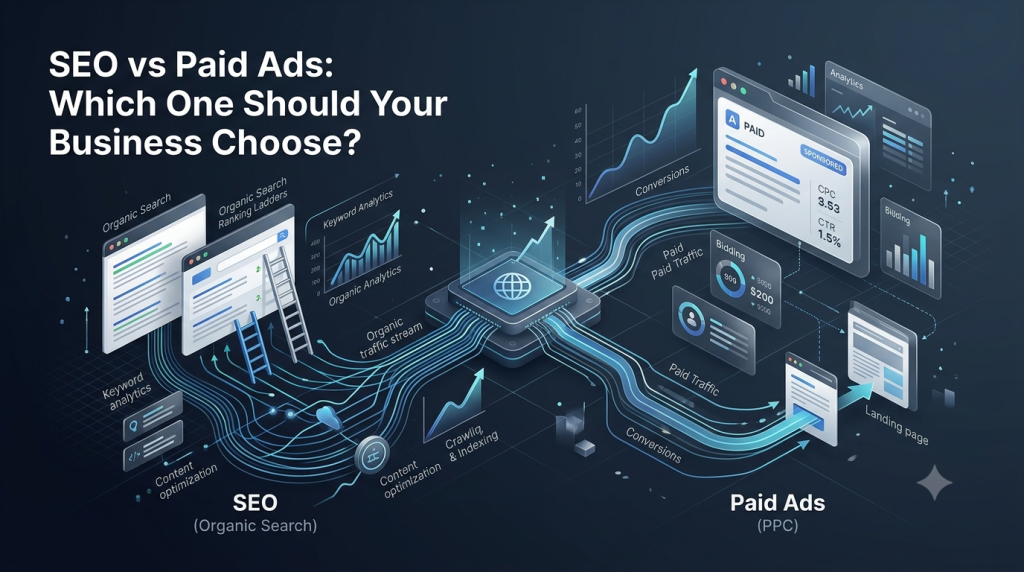
SEO earns visibility by making your site useful, trustworthy, and easy for search engines to understand. It takes time but tends to compound. Paid Ads buy visibility — you pay for placement and traffic shows up fast while campaigns are running. Neither is universally better. The right pick depends on your timeline, budget, competition, and conversion economics. Most growing businesses end up using both, with each channel playing a different role.
What Is SEO, Really?
Search engine optimization is the work of making a website easier to find in unpaid search results. It’s not about tricking Google. It’s about making your site clearer, more useful, and more credible than the alternatives competing for the same query.
That breaks into a few moving parts. Technical SEO keeps search engines able to crawl, render, and index your pages — site speed, mobile usability, structured data, canonical tags, and Core Web Vitals all live here. On-page SEO tunes each page so it matches what searchers actually want: titles, headings, internal links, and content quality. Content is the substance — genuinely useful answers built from first-hand experience, which is exactly what Google’s people-first guidance and E-E-A-T framework reward. And authority comes from earning links and mentions from other credible sites. Not by buying them — by publishing something worth citing.
Local SEO, e-commerce SEO, and digital PR are all extensions of the same idea, just pointed at different surfaces. The takeaway: SEO isn’t adding keywords. It’s a long-term investment in being the most useful result for a specific question.
What Are Paid Ads?
Paid Ads — often called PPC or paid search — means paying a platform to put your message in front of the right audience. The most familiar version is a Google Ads search campaign, but the category stretches much wider.
Here’s how a Google search campaign actually runs. You choose the search terms you want to show up for. When someone types one of those terms, Google runs an auction. Your bid matters, but so does your ad’s relevance and the quality of your landing page — Google’s Quality Score weighs all three. You pay when someone clicks (in most cases), and if conversion tracking is set up, you can see exactly what happened next.
Search is only one piece of the puzzle. Paid advertising also covers display, YouTube, Shopping, Performance Max, LinkedIn, Meta, and Microsoft Advertising. Each has its own rules, formats, and audience behavior.
One thing to get straight: paid placement is not organic ranking. You cannot pay Google to rank organically. Ads appear in clearly labeled spots; organic results show up based on Google’s judgment of relevance and quality — not your budget.
SEO vs Paid Ads: The Key Differences
The table below lays out the trade-offs side by side. Nothing here ranks one channel above the other — the point is to see where each one naturally fits.
| Factor | SEO | Paid Ads |
|---|---|---|
| Traffic source | Organic (unpaid) search results | Paid ad placements across platforms |
| Payment model | Investment in content, technical work, authority | Pay per click, impression, or conversion |
| Time to results | Typically 3–12 months | Days, once campaigns are approved |
| Visibility | Earned; depends on relevance and authority | Purchased; controlled by bid, budget, quality |
| Control | Indirect; you influence rankings but don't set them | Direct; full control over targeting and messaging |
| Long-term value | High; content and authority compound over time | Low to moderate; traffic stops when spend stops |
| Scalability | Scales with content volume and authority; slower | Scales quickly with budget; costs rise with competition |
| Testing | Slower feedback loops; weeks to see impact | Fast A/B testing on ads, audiences, landing pages |
| Conversion data | Harder to attribute directly; needs Search Console | Direct and detailed; conversion tracking built-in |
| Maintenance | Ongoing; content updates and technical health | Ongoing; optimization, bids, creative refresh |
| Risk | Algorithm updates, competition, slower ROI | Rising CPCs, ad fatigue, wasted spend without management |
| Best use cases | Long-term growth, authority, research-stage queries | Immediate visibility, launches, high-intent queries |
What Each Channel Actually Costs
SEO and Paid Ads don’t just have different price tags — they have different shapes of cost.
On the SEO side, you’re paying for content, technical work, tools, and outreach. Whether that’s an agency retainer, a freelancer, or internal hours, the reality is that SEO is not free traffic — it’s unpaid traffic that still costs real money to produce. Budget for content creation, developer time, keyword tools, digital PR, and ongoing optimization. Skip any of those and results lag.
On the Paid Ads side, the layers stack differently. You have ad spend, management fees, landing page work, creative assets, conversion tracking setup, and a testing budget. Every one of these affects your real cost per acquisition — and it’s easy to underestimate the ones that aren’t the ad spend itself.
The biggest mistake is assuming one benchmark applies to your business. CPCs swing wildly by industry, keyword, location, and season. Some businesses see clicks under a dollar. Others — legal, dental, competitive B2B software — routinely pay $75 to $150 or more for a single high-intent click. Benchmarks are useful for planning, not predicting.
How Fast Does SEO Actually Work?
Honest answer: it depends. Site authority, competition, content quality, and technical health all move the needle. But here’s a realistic range so you’re not caught off guard.
A brand-new site in a low-competition niche can see early traction in three to six months. An established site in a moderately competitive space usually needs six to twelve. If you’re chasing high-intent commercial keywords in a crowded market, plan on a year or more before organic really pulls its weight.
Local SEO is the exception worth knowing. Optimizing a Google Business Profile can move the needle in one to three months for map-pack visibility, with sustained gains over six to twelve. E-commerce product and category pages usually need four to twelve months before organic sales become meaningful.
None of this comes with a guarantee. Algorithms change. Competitors publish. Search behavior shifts. The work is iterative: publish, measure, refine, repeat.
How Fast Do Paid Ads Work?
Paid ads can go live within hours of approval. That speed is the whole point — but there’s a distinction worth sitting with.
Seeing an ad and getting a profitable conversion are two different things.
A fresh campaign goes through a learning phase. You’ll be adding negative keywords, pausing underperformers, tweaking landing pages, checking conversion tracking, and testing ad copy. The fast part is visibility. The profitable part takes work — sometimes weeks, sometimes a full quarter before the numbers settle.
Where SEO Wins
SEO shines when you play the long game. Strong rankings bring in traffic you don’t pay per click, and the top organic result alone earns roughly a quarter of all clicks on a results page. Content that ranks keeps working for months or years with periodic updates. Each new article adds to your site’s topical authority, so the whole becomes worth more than the sum of its parts. And organic results are often perceived as more trustworthy than ads — plenty of users skip straight past sponsored listings. Over time, organic visibility can reduce your blended acquisition cost and lower dependence on paid clicks.
The trade-offs are real: it’s slow, competitive, and never fully hands-off. Algorithm changes happen. Search demand has to exist for the topics you target. Rankings are not guaranteed — ever.
Where Paid Ads Win
Paid ads are built for speed and control. You can go live in hours. You can target by keyword, geography, device, time of day, and audience. You can test offers, messages, and landing pages in days rather than quarters. Conversion tracking tells you exactly what’s working and what’s wasting money. And you can scale up or shut off in a heartbeat.
The catch: spend doesn’t stop when campaigns do. Rising competition pushes CPCs up over time. Landing pages that don’t convert burn money fast. And if tracking is broken, you’re flying blind. Traffic also vanishes the moment you stop paying.
Short-Term vs Long-Term: Which Fits Your Situation?
If you need leads next week — a product launch, a seasonal promotion, an event push, or testing demand for something brand new — Paid Ads are almost always the more practical bet. They deliver visibility on day one and let you test messaging, offers, and audiences fast.
SEO can occasionally surprise you. A local business optimizing its Google Business Profile might see quick wins. A low-competition niche might rank in weeks. But as a general rule, SEO isn’t a short-term channel.
Flip the horizon and the picture changes. For long-term growth, SEO is usually the stronger play — content keeps attracting visitors, authority builds, and acquisition costs can fall as rankings mature. But SEO is not set-and-forget. Long-term growth means ongoing investment: refreshing content, monitoring technical health, adapting to new search behaviors, watching competitors, expanding into new topic clusters, and responding when SERPs shift.
When SEO Makes Sense — and When Paid Ads Do
SEO is worth evaluating if your business has a long-term growth horizon, operates in a market with real search demand, and can commit to content and site improvements for at least six to twelve months. It helps if you have genuine expertise to publish, want a presence that doesn’t depend on endless ad spend, and can target a range of informational and commercial queries across the customer journey. Patience is the price of entry.
Paid Ads fit when you need visibility now, want to test a new offer before committing to a long-term SEO push, or operate in a market where organic rankings take too long to build. They work well for location-specific campaigns, for businesses with a clear conversion path, and for teams that want rapid feedback on messaging and audience fit.
Profitability depends on your unit economics and how well the campaigns are run. A poorly managed account is expensive. A well-optimized one is often the fastest path to revenue.
Why Many Businesses Use Both
For a lot of businesses, the real question isn’t “SEO or Paid Ads.” It’s “what role should each one play?”
A startup with no organic footprint can run paid campaigns to validate demand and gather early leads while SEO infrastructure gets built in the background. An established service business can capture high-intent searches with paid ads while continuing to build authority for those same terms organically. An e-commerce store can lean on SEO for long-tail category visibility and switch on Shopping campaigns during promotions. A local business can pair local SEO for steady discovery with geo-targeted ads for specific services. A B2B company can use SEO to own research-stage content and paid campaigns to capture high-intent searches and reach named accounts on LinkedIn.
The two channels aren’t rivals. They cover different parts of the same journey — and the businesses that win treat them that way.
How to Think About Budget
There’s no magic number that tells you when to pick SEO over Paid Ads. What matters is your unit economics. Before deciding, work out your customer lifetime value, gross margin, average order value, lead value, conversion rate, customer acquisition cost, and how long you can wait to recover spend.
With a tight budget, check whether you can realistically compete for meaningful keywords on paid. If CPCs eat your margin, SEO may be the more efficient long-term path — start with low-competition, high-intent topics. With a moderate budget, test both: run a small paid campaign to validate messaging while investing in SEO content targeting the same audience. With a larger budget, integrate them — paid for high-intent capture and offer testing, SEO for compounding organic visibility and lower blended acquisition costs over time.
Measuring ROI Without Fooling Yourself
Comparing SEO and Paid Ads on traffic alone is a shortcut to bad decisions. What matters is what each channel contributes to leads, sales, and profit.
On the SEO side, track organic clicks, impressions, rankings, non-branded traffic, leads, revenue, assisted conversions, conversion rate, and your cost of investment. On the Paid Ads side, watch impressions, CTR, CPC, conversions, conversion rate, CPA, ROAS, and revenue.
Then connect those numbers to the ones that actually matter: customer acquisition cost, lifetime value, and payback period. A low CPC means nothing if the click never converts. High traffic means nothing if the revenue isn’t there.
Some quick definitions that keep things honest. CAC is total marketing and sales spend divided by new customers acquired. LTV is average purchase value times purchase frequency times average customer lifespan. ROAS is revenue from ads divided by ad spend — useful, but it ignores costs of goods and overhead. Conversion rate is conversions divided by visitors, times 100. Get these right before you scale anything.
What AI Search Changes (and What It Doesn't)
Search behavior is shifting. AI Overviews, conversational search, and answer engines are changing how people find and consume information. By some 2026 estimates, AI Overviews appear on roughly 48% of tracked queries — up from about 30% a year earlier. When they show up, click-through rates on traditional organic links drop significantly.
None of this means SEO is dead. It means the discipline is widening. Traditional SEO still gets your content indexed and understood. But increasingly, you also need to think about AEO (Answer Engine Optimization) and GEO (Generative Engine Optimization) — how clearly you answer questions, how well your entities are defined, and how structured your content is.
What tends to matter for AI-powered visibility: direct answers to common questions, strong entity definition, logical heading structure, first-hand expertise, authoritative citations, and content that demonstrates real experience. Google’s own documentation keeps pointing back to the same foundation — helpful content, clear structure, technical health.
Paid Ads face their own shifts too. Rising CPCs and AI-driven auction dynamics push advertisers to sharpen targeting and landing pages. But the core value — immediate visibility and control — hasn’t changed.
Mistakes That Cost Real Money
- Treating SEO as free marketing
- Treating Paid Ads as guaranteed sales
- Looking at traffic instead of conversions
- Ignoring conversion tracking entirely
- Choosing keywords without understanding intent
- Sending ads to weak landing pages
- Publishing content without search intent research
- Expecting immediate SEO results
- Running Paid Ads without testing
- Stopping SEO too early
- Ignoring customer lifetime value
- Comparing channels on unrelated metrics
- Forgetting brand searches in the mix
- Ignoring the overlap between organic and paid
- Making decisions based only on competitor activity
The Decision Framework
Step 1 — What’s your primary goal? Immediate leads or sales → evaluate Paid Ads. Long-term organic visibility → evaluate SEO. Both → evaluate both.
Step 2 — How fast do you need results? Days or weeks → Paid Ads. Months or quarters → SEO or both.
Step 3 — What’s your available budget? Can you sustain monthly ad spend? Can you invest in content and technical work?
Step 4 — Is there real search demand? If people are actively searching for what you offer, both channels can work. If not, search may not be the right channel at all.
Step 5 — How competitive is the market? High competition usually means high CPCs and longer SEO timelines. Factor that into your planning.
Step 6 — What are your conversion economics? If LTV is high and CAC is manageable, paid acquisition can work. If margins are tight, SEO’s longer-term efficiency may matter more.
Step 7 — Can you create and maintain useful content? SEO requires consistent content investment. If you can’t sustain it, Paid Ads may be the more realistic path.
Step 8 — Can you accurately track conversions? Without proper tracking, you’re flying blind in both channels. Fix measurement before scaling spend.
Choose based on your business economics and objectives — not marketing hype.
Frequently Asked Questions
Make the Decision That Fits Your Business
SEO and Paid Ads aren’t rivals in a winner-takes-all contest. They solve different parts of the same problem. Paid Ads give you speed, control, and immediate visibility. SEO gives you compounding authority, sustainable organic traffic, and a presence that isn’t tied to monthly spend.
Which one you lean on — or how you combine them — depends on your objectives, timeline, budget, competition, customer journey, search demand, conversion economics, and internal capabilities. There’s no universal answer, and anyone who says otherwise is selling something.
The real move is to decide based on measurable outcomes. Not traffic. Not rankings. Not clicks. Leads, sales, revenue, profit, and acquisition cost. If you’re unsure where to start, fix your measurement first. Get conversion tracking right. Understand your unit economics. Then make a decision you can honestly evaluate and adjust.
Not Sure Where SEO or Paid Ads Fit in Your Strategy?
A professional audit can clarify where your biggest opportunities lie. Whether that’s technical SEO improvements, paid campaign optimization, or a coordinated approach that uses both channels strategically — a clear-eyed assessment beats guesswork every time.