SEO vs Paid Ads: Which One Should Your Business Choose?
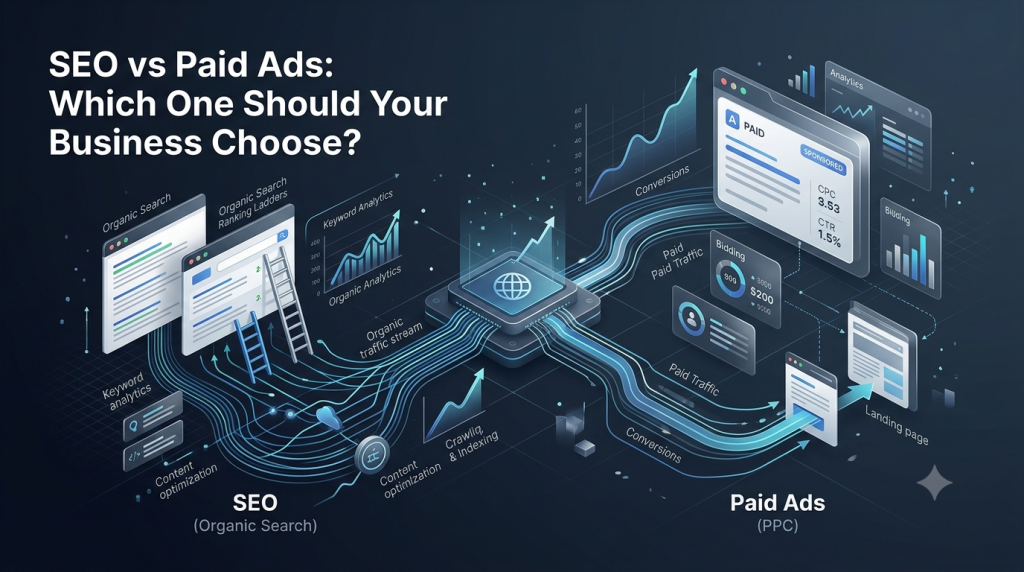
It’s the most common question in digital marketing, and it almost never has a clean, one-size-fits-all answer. Some businesses swear by organic search. Others say paid ads saved their quarter. Both groups are right — for their specific situation. SEO and Paid Ads don’t solve the same problem. They run on different timelines, different cost structures, and different risk profiles. Picking between them isn’t about crowning a winner. It’s about matching the channel to your goals, your cash flow, your competition, and how your customers actually buy. What follows isn’t hype. It’s a practical walk-through — how both channels really work, what they cost, how fast they deliver, and when each one earns its place in your budget. The Short Answer SEO earns visibility by making your site useful, trustworthy, and easy for search engines to understand. It takes time but tends to compound. Paid Ads buy visibility — you pay for placement and traffic shows up fast while campaigns are running. Neither is universally better. The right pick depends on your timeline, budget, competition, and conversion economics. Most growing businesses end up using both, with each channel playing a different role. What Is SEO, Really? Search engine optimization is the work of making a website easier to find in unpaid search results. It’s not about tricking Google. It’s about making your site clearer, more useful, and more credible than the alternatives competing for the same query. That breaks into a few moving parts. Technical SEO keeps search engines able to crawl, render, and index your pages — site speed, mobile usability, structured data, canonical tags, and Core Web Vitals all live here. On-page SEO tunes each page so it matches what searchers actually want: titles, headings, internal links, and content quality. Content is the substance — genuinely useful answers built from first-hand experience, which is exactly what Google’s people-first guidance and E-E-A-T framework reward. And authority comes from earning links and mentions from other credible sites. Not by buying them — by publishing something worth citing. Local SEO, e-commerce SEO, and digital PR are all extensions of the same idea, just pointed at different surfaces. The takeaway: SEO isn’t adding keywords. It’s a long-term investment in being the most useful result for a specific question. What Are Paid Ads? Paid Ads — often called PPC or paid search — means paying a platform to put your message in front of the right audience. The most familiar version is a Google Ads search campaign, but the category stretches much wider. Here’s how a Google search campaign actually runs. You choose the search terms you want to show up for. When someone types one of those terms, Google runs an auction. Your bid matters, but so does your ad’s relevance and the quality of your landing page — Google’s Quality Score weighs all three. You pay when someone clicks (in most cases), and if conversion tracking is set up, you can see exactly what happened next. Search is only one piece of the puzzle. Paid advertising also covers display, YouTube, Shopping, Performance Max, LinkedIn, Meta, and Microsoft Advertising. Each has its own rules, formats, and audience behavior. One thing to get straight: paid placement is not organic ranking. You cannot pay Google to rank organically. Ads appear in clearly labeled spots; organic results show up based on Google’s judgment of relevance and quality — not your budget. SEO vs Paid Ads: The Key Differences The table below lays out the trade-offs side by side. Nothing here ranks one channel above the other — the point is to see where each one naturally fits. Factor SEO Paid Ads Traffic source Organic (unpaid) search results Paid ad placements across platforms Payment model Investment in content, technical work, authority Pay per click, impression, or conversion Time to results Typically 3–12 months Days, once campaigns are approved Visibility Earned; depends on relevance and authority Purchased; controlled by bid, budget, quality Control Indirect; you influence rankings but don’t set them Direct; full control over targeting and messaging Long-term value High; content and authority compound over time Low to moderate; traffic stops when spend stops Scalability Scales with content volume and authority; slower Scales quickly with budget; costs rise with competition Testing Slower feedback loops; weeks to see impact Fast A/B testing on ads, audiences, landing pages Conversion data Harder to attribute directly; needs Search Console Direct and detailed; conversion tracking built-in Maintenance Ongoing; content updates and technical health Ongoing; optimization, bids, creative refresh Risk Algorithm updates, competition, slower ROI Rising CPCs, ad fatigue, wasted spend without management Best use cases Long-term growth, authority, research-stage queries Immediate visibility, launches, high-intent queries What Each Channel Actually Costs SEO and Paid Ads don’t just have different price tags — they have different shapes of cost. On the SEO side, you’re paying for content, technical work, tools, and outreach. Whether that’s an agency retainer, a freelancer, or internal hours, the reality is that SEO is not free traffic — it’s unpaid traffic that still costs real money to produce. Budget for content creation, developer time, keyword tools, digital PR, and ongoing optimization. Skip any of those and results lag. On the Paid Ads side, the layers stack differently. You have ad spend, management fees, landing page work, creative assets, conversion tracking setup, and a testing budget. Every one of these affects your real cost per acquisition — and it’s easy to underestimate the ones that aren’t the ad spend itself. The biggest mistake is assuming one benchmark applies to your business. CPCs swing wildly by industry, keyword, location, and season. Some businesses see clicks under a dollar. Others — legal, dental, competitive B2B software — routinely pay $75 to $150 or more for a single high-intent click. Benchmarks are useful for planning, not predicting. How Fast Does SEO Actually Work? Honest answer: it depends. Site authority, competition, content quality, and technical health all move the needle. But here’s a realistic range so you’re not caught off guard. A brand-new